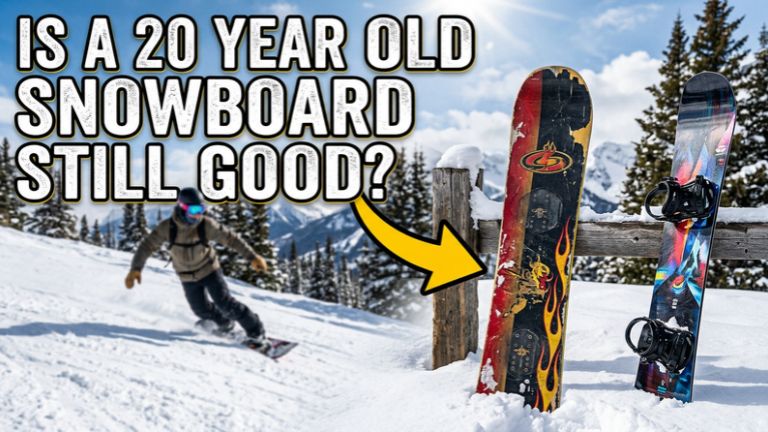
A 20 year old snowboard can absolutely still be good, but the board’s age is close to the least useful thing you can check.
What actually decides it is the same handful of structural points you’d look at on any used board, plus one part that almost never survives two decades in usable shape: the bindings.
Treat the number on the manufacture sticker as background information, not a verdict, and work through the board itself before you decide anything.
What Actually Determines Whether a 20 Year Old Board Is Still Good
Run your finger along both edges and look for rust that won’t clean off, nicks, or any spot where the metal has pulled away from the base or sidewall.
Then check the base for gouges and especially for a core shot, damage deep enough that you can see the internal core material through the base layer.
Light scratching after twenty years is completely normal and says nothing about whether the board rides well.
What matters is whether the topsheet is bubbling or peeling away from the core, and whether the board still holds the camber or rocker profile it was built with when you set it flat on the ground, rather than sitting dead flat or reverse curved in sections that should still curve.
A full walkthrough of each of these checks, including how to tell a core shot apart from an ordinary base scratch, is worth doing properly rather than eyeballing it: see our guide to inspecting a used snowboard for the complete list.
The edges specifically are worth a closer look of their own, since a board that’s ridden well for twenty years but never had its edges maintained can develop the kind of dullness and minor rust that sharpening fixes in an afternoon rather than ruining the board for good.
Why the Bindings Are Usually the Real Problem, Not the Board
Store a wood core board flat and out of direct sun and it can genuinely hold its structure for decades, which is longer than most riders expect. Plastic doesn’t get the same deal.
Manufacturers tell owners to replace a snowboard helmet every five years regardless of visible damage, because the foam and plastic inside it break down from temperature swings and UV exposure even sitting untouched in a closet.
That same aging process applies just as directly to the plastic housings, straps, and buckles on a set of twenty year old bindings: a helmet that’s sat in a garage for two decades hasn’t been spared the clock just because nobody wore it, and bindings built from the same generation of plastics and glues are not either.
The straps and buckles are usually the part of an old setup that’s quietly failed before the board has, a strap that looks fine right up until it snaps the first time it’s loaded, or a buckle that no longer closes securely.
Boots the same age as the board carry the same plastic-parts-and-worn-liners problem. None of this means the board is bad. It means budgeting for new bindings, and probably new boots, is close to a given on anything this old, separately from whatever the board itself tells you.
A Base That Looks Tired Isn’t Necessarily Dead
Years of sitting unused, or years of riding without much care, usually leave a base looking dry, chalky, or grey rather than the deep black of a properly maintained one. That appearance on its own isn’t a reason to write the board off.
Dried-out base material is what happens when wax wears away and isn’t replaced, and it’s reversible: a proper wax restores the glide and puts a protective layer back over material that’s been drying out, sometimes for years.
If the rest of the structural checks above come back clean, a slow, dull feeling board is frequently a waxing problem rather than a core problem.
Our full walkthrough of waxing a snowboard covers the process end to end, including how long a single wax actually lasts if the board then goes back into storage.
When Age Alone Should Make You Walk Away
Some findings end the conversation regardless of how good everything else looks.
Edges that have visibly cracked or separated from the core in any section are a safety issue, not a cosmetic one, since a loose section can catch unpredictably mid turn.
Delamination, meaning the topsheet or base visibly bubbling or peeling away from the core, is a structural failure that gets worse with time and isn’t something a repair shop can reliably fix for good.
Moisture has a direct path into the wood through a core shot sitting right at the edge, which is a different problem from one away from the edge that’s already been properly repaired.
Lost camber is the clearest tell of all: a board sitting flat or reverse curved, with a flex that feels dead rather than springy compared to a healthy board of the same model, has a core that’s broken down structurally in a way that two more decades of careful storage won’t undo.
None of this is about the number of years on the board.
A five year old board stored wet in a garage can show every one of these; a well kept twenty year old board can show none.
The Short Version
Age is a starting point for suspicion, not a conclusion.
Work through the board the same way you’d check any secondhand one: edges, base, topsheet, and camber first, because those tell you whether the core itself is still sound.
Expect the bindings, and possibly the boots, to need replacing on a timeline that has very little to do with the board’s own condition.
And don’t let a dull, dry looking base talk you out of a structurally healthy board before you’ve actually waxed it.