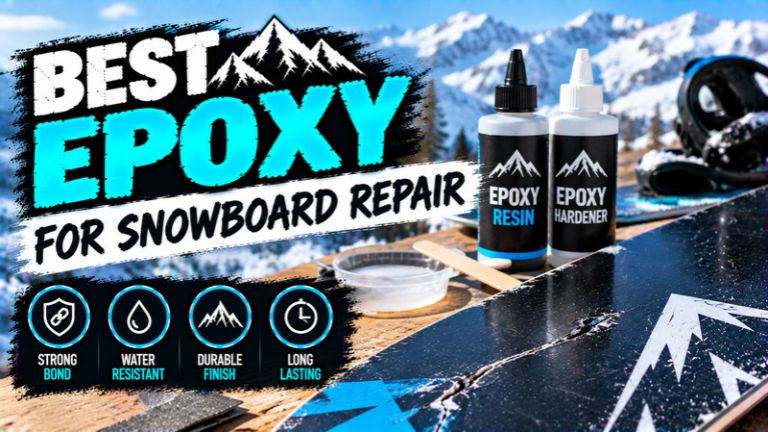
A delaminated edge or a core shot can end a season if you patch it with the wrong glue. We looked at four popular epoxies, using manufacturer specs and what snowboard and ski repair forums actually report, to find the best epoxy for snowboard repair and to explain where each one falls short.


West System G/Flex 650 Epoxy
- Flexible 150,000 psi modulus absorbs shock and flexing
- Simple 1:1 mix by volume
- 45 minute pot life, 75 minute working time
- Bonds plastics, fiberglass, metal, and damp wood
- Not stocked in most hardware stores, usually bought online
- Needs a full 24 hours to cure completely
Overview
West System’s G/flex is a toughened epoxy made for bonds that move. It is a favorite among snowboard and ski repairers because it stays strong without turning brittle.
Key features and benefits
- Toughened, flexible two-part epoxy, 1:1 mix by volume
- 45 minute pot life and 75 minute working time at 72°F
- Working cure in 7 to 10 hours, full cure in 24 hours
- Bonds plastics, fiberglass, metals, and damp wood
- Can be thickened with fillers or used to wet out fiberglass
Why We Recommend It
We rank G/flex first because a snowboard flexes every turn, and a rigid epoxy cracks along the repair. G/flex has a modulus of elasticity of 150,000 psi, compared with 450,000 psi for West System’s standard 105/205 epoxy, so it can deflect much further before it breaks while still being a true structural adhesive.
Repair forums back this up. One snowboarder confirmed a DPS engineer recommended G/flex for a snowboard tip repair, another called it very strong but flexible unlike most epoxies, and a third said a standard hardware store marine epoxy cracked after a day of riding while they switched to G/flex.
It is also forgiving to use. The 1:1 mix is hard to get wrong, the 45 minute pot life leaves time to work the epoxy into a delaminated edge, and it gels in 3 to 4 hours at 72°F. Clamp the repair and leave it for 24 hours, and keep it in the 60 to 80°F range for the best results.
G/flex 650 is the thin liquid version for getting between layers and wetting out fiberglass, and West System also sells a thickened G/flex 655 for filling gaps. For delams and core repairs, this is the clear best pick.
2. J-B Weld MarineWeld
J-B Weld MarineWeld
- Steel-reinforced two-part epoxy
- Waterproof once cured, bonds fiberglass, metal, and composites
- Cures to a dark gray that can be sanded, drilled, and filed
- Easy 1:1 mix and widely available
- Rigid when cured, so it does not flex with a board
- Spec sheets differ, listing 3,960 or 5,020 psi tensile strength
Overview
MarineWeld is J-B Weld’s waterproof, steel-reinforced epoxy putty, a two-tube system that is easy to find and can fill and seal damaged areas.
Key features and benefits
- 1:1 mix of two 1 oz tubes
- Sets in 4 to 6 hours, cures in 15 to 24 hours
- Steel reinforced, waterproof once cured
- Bonds fiberglass, metal, composites, and plastics
- Can be sanded, drilled, and filed after curing
Why We Recommend It
We include MarineWeld as the second choice because a ski-shop style repair guide specifically suggests a marine-grade waterproof epoxy or a reinforced product like J-B Weld to patch a core shot before filling the base with P-tex. Sealing the core matters because water seeping into a wood core causes further damage.
It is a thick, putty-like epoxy that fills gaps well, sets in 4 to 6 hours, and cures to a hard, sandable finish. It is waterproof once cured and bonds fiberglass, metal, and composites, which makes it good for sealing exposed core and filling small chunks.
The big caveat is flexibility. Several forum users note that J-B Weld does not flex at all, so for a delaminated area that bends every turn, it is likely to crack. Treat it as a core sealer and filler rather than a delam glue.
For riders patching a core shot who want a widely available, waterproof, sandable epoxy, it is a reasonable second pick.
3. Loctite Marine Epoxy
Loctite Marine Epoxy
- Dual syringe dispenses equal parts for a correct mix
- Waterproof and can be applied and cured underwater
- Sandable and machinable
- Bonds metal, glass, ceramics, and most plastics
- Cures to a tough, rigid bond that can crack on a flexing board
- Set time is listed as 50 minutes at some retailers and 2 hours at others
Overview
Loctite’s Marine Epoxy is a convenient dual-syringe epoxy that is widely sold at hardware stores, with a pre-measured mix and a waterproof cure.
Key features and benefits
- 0.85 fl oz dual syringe, equal parts resin and hardener
- Sets in about 50 minutes to 2 hours, cures in 24 hours
- Waterproof and can cure underwater
- Does not shrink, sandable and machinable
- Bonds metal, glass, ceramics, and most plastics
Why We Recommend It
We include the Loctite as the easy-to-find option. The dual syringe takes the guesswork out of mixing, and Loctite says it sets in around 50 minutes to 2 hours and fully cures in 24 hours, which is slower than a 5-minute epoxy and gives you time to position a repair.
The formula is waterproof, does not shrink, and can be sanded or machined. Manufacturer materials describe the cured bond as tough and rigid, with a rated strength around 3,000 psi.
That rigidity is the problem for snowboards. Our independent reviewer reported that the cheap hardware-store Loctite marine epoxy began cracking after a day of riding, even with careful prep, and they switched to G/flex. That is an older anecdote, but it fits how rigid epoxies behave on a flexing board.
For small, non-flexing fixes, like a binding insert area or a rigid accessory, it works fine, but we would not use it for a delamination.
4. Hardman Double Bubble Epoxy
Hardman Double Bubble Epoxy
- Extra-fast 3 to 5 minute working time
- Handling strength in 15 to 60 minutes
- Pre-measured double packs, no mixing ratio to get wrong
- Cures even at temperatures down to 0°F
- Fast-setting rigid epoxy, not structural or flexible
- Each pack holds only about 3.5 grams
Overview
Hardman’s Double Bubble Red is a classic fast-setting epoxy sold in tiny, pre-measured double packs, popular for golf clubs, tools, and quick repairs.
Key features and benefits
- Extra-fast 3 to 5 minute working time
- Handling strength in 15 to 60 minutes, full cure in 24 hours
- Pre-measured double packs of about 3.5 grams each
- Dries clear and does not shrink
- Cures at room temperature down to 0°F
Why We Recommend It
We include the Double Bubble because it is a good emergency fix. The pre-measured packs mean no mixing, it handles cold temperatures better than most epoxies, and a small amount can hold something in place in minutes.
But it is the wrong tool for a structural snowboard repair. Our advice is blunt: avoid 5-minute epoxies, because they are not nearly as strong or water resistant as a slow-cure epoxy like G/flex, and a ski-shop guide says a 24-hour marine-grade epoxy is usually a better choice than the 5-minute hardware store variety.
Each pack holds only about 3.5 grams, so it is also too small for filling a long delamination. Use it to tack a loose piece in place on the hill, then repair it properly at home.
For riders who want a pocket-sized stopgap for a loose edge or a broken accessory, it is handy, but not a replacement for a proper repair.
Buyer’s Guide
This snowboard epoxy buyer’s guide explains which types work best, what to look for when you buy, and which repairs call for epoxy and which do not.
What Type of Epoxy Is Best for Snowboard Repair?
Different repairs need different adhesive properties. Whenever possible, choose products made specifically for ski or snowboard repair. Look for strong bonding, water resistance, flexibility, and good performance in cold conditions. A general-purpose epoxy may work for some jobs, but it is not designed for a board that flexes, vibrates, and sits in snow.
Flexible or Toughened Epoxy
A tougher, somewhat flexible epoxy helps in areas exposed to vibration and repeated flexing. Examples include topsheet separation and certain delamination repairs. A very hard, brittle epoxy can crack as the board bends, which lets moisture back in. A cured bond that flexes slightly often lasts longer in these spots.
Two-Part Epoxy
Two-part epoxy combines a resin and a hardener. When mixed, they react to form a durable bond. Follow the manufacturer’s mixing ratio and curing requirements exactly. Common ratios are 1:1 or 2:1 by volume, but always check your product. A wrong ratio can leave the epoxy soft, sticky, or weak.
Keep in mind that “two-part” describes a formulation. It is not a guarantee of flexibility or suitability for snowboard repair. Always check the product’s stated uses.
Fast-Curing vs. Slow-Curing Epoxy
Fast-curing epoxy is convenient for small, simple repairs. It sets quickly, so you can move on. Slower-curing products give you more time to position parts and clamp them. The best choice depends on the repair and the product specifications. For a large delamination, extra working time can make the job easier.
What to Look for When Buying Snowboard Repair Epoxy
Seven features matter most when you compare products.
Flexibility After Curing
The cured adhesive should suit the movement and stress of the repair area. Harder is not always better. A bond that moves with the board is less likely to crack.
Water Resistance
Exposed core materials and bonded areas need protection from moisture. Choose an epoxy with good water resistance so the repair does not let water back in.
Bonding Compatibility
Look for explicit compatibility with the relevant materials, such as wood, fiberglass, metal, or the board’s topsheet. Not every epoxy bonds well to every plastic. It is especially difficult to bond to polyethylene snowboard bases, which is why many base repairs use different methods.
Working Time and Cure Time
Working time is how long the epoxy stays usable after mixing. Cure time is how long it takes to reach its stated strength. These are not the same. A product may stay workable for 5 minutes but need 24 hours or more to fully cure. Check both numbers.
Viscosity and Application
A thicker formula stays in place on vertical or uneven areas. A lower-viscosity formula can flow into a narrow gap, which helps with certain bonding jobs. Match the thickness to the repair.
Temperature Requirements and Durability
Check the manufacturer’s application and curing temperature range. Many epoxies cure best in room-temperature conditions, so a cold garage may slow or weaken the cure. Also check the cured product’s stated service-temperature limits to make sure it holds up in cold weather.
Package Size and Value
Compare the amount provided with the amount you need. A larger package is not always better. Some products have a limited shelf life after opening, so you may waste a lot if you only do one small repair.
Which Epoxy Is Best for Different Snowboard Repairs?
This section ties product features to the problem you want to fix.
Topsheet Chips and Separation
A compatible, durable adhesive may work for bonding separated topsheet material or sealing a chip that exposes underlying layers. Clean the area, let it dry, and follow the product directions.
Sidewall Damage
Use an adhesive compatible with the sidewall and nearby materials. Extensive damage may need a professional assessment.
Delamination Near the Tip or Tail
Bonding strength, appropriate flexibility, and the ability to hold separated layers together during curing all matter here. Clamping is often needed. These areas flex a lot, so a flexible epoxy often suits them better.
Exposed Core Material
A suitable epoxy may help seal exposed core against moisture in some repairs. The right repair depends on the depth and location of the damage. Do not ignore exposed core, since water can spread and cause bigger problems.
Loose or Damaged Metal Edges
Some specialized epoxies are used in edge repairs. But damage involving a detached, bent, or cracked edge should be assessed by a snowboard repair professional.
Deep Gouges in the Snowboard Base
Epoxy is not a universal base-filling material. Many ordinary base gouges are repaired with P-Tex. Damage that exposes core, fiberglass, or an edge may need a different repair approach, so assess the depth first.
Pros and Cons of Using Epoxy for Snowboard Repair
Epoxy is useful, but it is not magic. Here is how the advantages and limitations compare.
| Advantages | Limitations |
|---|---|
| Can bond separated layers and damaged components | Not suitable for every type of base damage |
| Can help seal exposed core material against moisture | Requires proper surface preparation and curing |
| Some formulations offer good water resistance | Some formulations may become brittle under repeated flexing |
| Useful for certain topsheet, sidewall, and structural bonding repairs | Incorrect mixing or application can lead to a failed repair |
| Available in different working times and viscosities | Serious structural damage may require professional equipment and expertise |
Final Thoughts
The best epoxy for snowboard repair is a slow-curing, flexible one, and West System G/flex 650 is the clear winner for delamination, tip and edge separations, and anything that has to flex with the board.
J-B Weld MarineWeld is a sensible second option for patching a core shot, where a hard, waterproof fill is the goal. The Loctite Marine Epoxy and Hardman Double Bubble are better kept for small rigid fixes and emergencies than for structural repairs.
Whichever you choose, good prep matters as much as the product. Clean and dry the area, let any solvent evaporate fully, clamp the repair, and give it a full 24 hours before you ride.
Can I use any epoxy to repair a snowboard?
Not well. A snowboard flexes constantly, so a rigid epoxy can crack along the repair. A slow-curing flexible epoxy like West System G/flex is the common recommendation for delaminations and edge separations.
Why is a flexible epoxy better?
G/flex has a modulus of elasticity of 150,000 psi, versus 450,000 psi for West System’s standard 105/205 epoxy, so it can bend much further before breaking. That lets it absorb the flex, shock, and vibration of riding.
Are 5-minute epoxies okay for snowboard repair?
They are fine for temporary fixes, but forum repairers advise avoiding them for structural repairs because they are not as strong or water resistant as slow-cure epoxies. A repair guide also says a 24-hour marine-grade epoxy is usually the better choice.
How long does G/flex take to cure?
At 72°F, G/flex has a 45 minute pot life, gels in about 3 to 4 hours, reaches a working cure in 7 to 10 hours, and cures fully in 24 hours. It cures in cool temperatures, but 60 to 80°F gives the best results.
How should I prepare the damaged area?
Clean and dry the area, remove loose material, and wipe it with a solvent such as acetone, letting it fully evaporate before applying epoxy. Work the epoxy into the gap, clamp the repair, and leave it for the full cure.
Can epoxy fix a core shot in the base?
A deep gouge that reaches the core should be sealed first with a waterproof marine epoxy, or a reinforced epoxy like J-B Weld, to keep water out of a wood core. Then fill the base with a P-tex patch and let the epoxy cure completely.
What is the difference between G/flex 650 and 655?
G/flex 650 is the thin liquid version that wets out fiberglass and flows between layers, while 655 is pre-thickened for filling gaps. You can also thicken 650 with West System fillers.
When should I take my board to a repair shop?
If the damage is a broken core, a large delamination, or damage near the binding inserts, a shop has the clamps, presses, and materials to restore the board’s structure. A DIY patch is best for small delams and edge separations.