Finding the right size for your snowboard gloves or mittens is the single most effective way to ensure your hands stay warm, dry, and responsive on the mountain. A pair of gloves made with top-tier GORE-TEX membranes and heavy-duty PrimaLoft insulation will still leave your fingers freezing if the fit restricts your circulation or leaves too much dead space.
Whether you are carving up groomed trails, lapping the terrain park, or searching for deep powder lines, this comprehensive snowboard glove size guide walks you through exact hand measurement techniques, master size charts, fit mechanics, and material nuances.
Quick Summary: The Ideal Fit Rule
Before diving into detailed measurement steps, keep this primary rule of thumb in mind when fitting snowboard gloves and mittens:
The ¼-Inch Clearance Rule: Your gloves should fit snugly around the palm and wrist without pinching or binding, leaving approximately ¼ inch (0.5 to 1 cm) of clearance between your fingertips and the end of the glove.
- If your gloves are too tight: You compress the interior thermal insulation and restrict blood circulation, directly causing cold, numb fingers.
- If your gloves are too loose: Cold air pockets form inside the shell, and loose interior lining bunches up, destroying your dexterity when adjusting binding ratchets or zipping jackets.
Snowboard Glove Size Chart
| Size Tag | Hand Circumference (IN) | Hand Circumference (CM) | Hand Length (IN) | Hand Length (CM) |
|---|---|---|---|---|
| XS | 6.5″ – 7.0″ | 16.5 – 17.8 cm | 6.0″ – 6.5″ | 15.2 – 16.5 cm |
| S | 7.0″ – 7.5″ | 17.8 – 19.0 cm | 6.5″ – 7.0″ | 16.5 – 17.8 cm |
| M | 7.5″ – 8.5″ | 19.0 – 21.6 cm | 7.0″ – 7.5″ | 17.8 – 19.0 cm |
| L | 8.5″ – 9.5″ | 21.6 – 24.1 cm | 7.5″ – 8.0″ | 19.0 – 20.3 cm |
| XL | 9.5″ – 10.5″ | 24.1 – 26.7 cm | 8.0″ – 8.5″ | 20.3 – 21.6 cm |
| XXL | 10.5″+ | 26.7 cm+ | 8.5″+ | 21.6 cm+ |
How to Measure for Snowboard Gloves
To determine your correct size using any snowboard glove size chart, you need two precise measurements of your dominant hand: Hand Circumference and Hand Length. Because your dominant hand is typically slightly larger, always base your sizing on that hand.
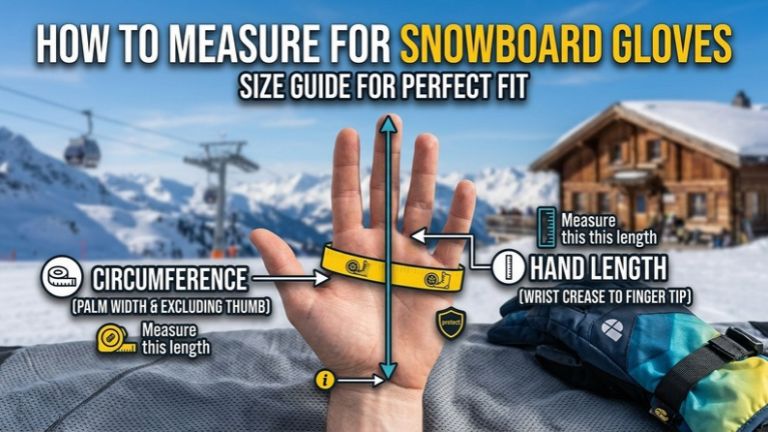
Step 1: Measure Hand Circumference
- Open your dominant hand flat with your fingers extended together.
- Wrap a flexible tailor’s measuring tape around your palm at the knuckles (the widest part of your hand).
- Do not include your thumb in this measurement.
- Keep the tape taut against your skin, but do not pull so tightly that it pinches.
- Record the measurement in both inches and centimeters.
Step 2: Measure Hand Length
- Place your dominant hand flat on a smooth surface with your fingers spread naturally.
- Locate the main crease line at the base of your palm (where your wrist meets your hand).
- Measure in a straight vertical line from that wrist crease up to the very tip of your middle finger.
- Record the measurement in both inches and centimeters.
Step 3: Match Your Measurements
Compare your numbers against the master chart below. If your circumference points to a Size Medium but your finger length points to a Size Large, always prioritize Hand Circumference. A glove with slightly longer fingers still retains heat, whereas a glove that squeezes the width of your palm cuts off blood flow and leads to instant freezing.
How Tight Should Snowboard Gloves Be?
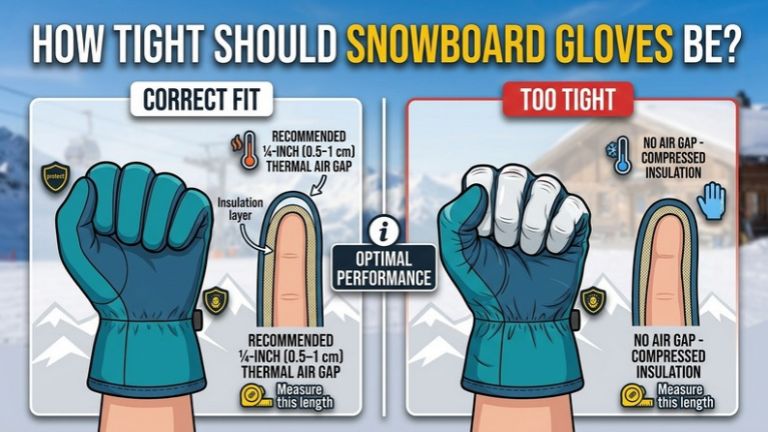
Understanding how tight snowboard gloves should be requires looking beyond static measurements to real-world movement. When sitting comfortably at home, a pair of gloves might feel snug, but on the mountain, your hands perform constant micro-movements: gripping lifts, ratcheting ladder straps, carrying your board, and absorbing impacts.
+-----------------------------------------------------------------------+
|                       THE FIT CHECKLIST TEST                                                                                    |
+-----------------------------------------------------------------------+
| 1. Make a tight fist. Does the material dig painfully into webbings?                           |
| 2. Pinch the fingertips. Is there 1/4 inch (0.5-1 cm) of air cushion?                             |
| 3. Reach up. Does the wrist cuff stay sealed around your jacket sleeve?                 |
+-----------------------------------------------------------------------+
The Cold Finger Paradox (The Danger of Tight Gloves)
Heat retention inside a snowboard glove does not come from the fabric alone—it comes from trapped warm air. Synthetic loft insulation (like Thinsulate or PrimaLoft) works by trapping air molecules warmed by your body’s radiant heat.
When gloves are too small:
- Your hands compress the loft material flat, eliminating air pockets.
- Pressure along the webbings of your fingers restricts capillary blood flow.
- Cold air from the outside quickly conducts through the compressed fabric, resulting in cold, aching fingers despite wearing expensive gear.
The Dexterity Loss Problem (The Danger of Loose Gloves)
When gloves are oversized, your hands move around inside the shell while the exterior remains stationary.
- Dead space requires your hand muscles to work twice as hard to squeeze binding ratchets or grab board rails.
- Excess fingertip material catches on zipper pulls and jacket pockets.
- Interior moisture-wicking liners bunch up when you pull your hands out, making it difficult to slide your fingers back into place.
Critical Sizing Nuances & Gear Variables
Different riding styles, weather conditions, and protective gear influence how you should size your gloves.
+-----------------------------------------------------------------------+
| SIZING VARIABLES                        |   IMPACT ON SIZING                                                       |
+--------------------------+--------------------------------------------+
| Gloves vs. Mittens                      |   Mittens offer a more forgiving fit.                             |
| Removable Glove Liners           |   Size UP by 1 full size.                                                     |
| Impact Wrist Guards                 |   Size UP by 1 to 2 full sizes.                                           |
| Leather Construction                 |   Stretches 3-5% over time (Keep snug).                 |
| Synthetic GORE-TEX                   |   Fixed shape (Will NOT stretch).                                |
+-----------------------------------------------------------------------+
1. 5-Finger Gloves vs. Mittens vs. Trigger Mitts
- 5-Finger Gloves: Require precise sizing across both length and circumference. Ideal for park riders, instructors, and anyone needing maximum dexterity for adjusting gear.
- Mittens: Group your fingers together inside a shared thermal pouch, reducing surface area exposed to cold air. Mittens are far warmer and much more forgiving on finger length dimensions.
- 3-Finger / Trigger Mitts: Combine the index finger dexterity of a glove with the thermal efficiency of a mitten. Size these primarily based on index finger length and palm circumference.
2. Accounting for Glove Liners & Wrist Guards
- Removable Touchscreen Liners: If you wear thin thermal liner gloves under your main shell for cold-weather days, size up by one full size.
- Internal Wrist Guards: Protective wrist guards (like those from Level or Dakine) add substantial volume around your palm and wrist. Always buy gloves designed specifically with integrated guards, or size up by 1 to 2 full sizes if inserting aftermarket guards into standard shells.
3. Leather Break-In vs. Synthetic Shells
- Full Leather (Goat/Cowhide): High-end leather gloves (e.g., Hestra, Kinco, Oyuki) break in like a pair of boots. They stretch 3% to 5% over the first 5 to 10 riding days as they absorb natural hand oils and body heat. Buy leather gloves snug; they will conform perfectly to your hand over time.
- Synthetic Shells (Nylon/Polyester): Fabric gloves with GORE-TEX or DWR coatings do not stretch. If a synthetic glove feels slightly tight at purchase, it will remain tight for its entire lifespan.
Brand-Specific Glove Sizing Directory
Sizing varies slightly across major snowboard brands depending on their origin and target fit profile. Explore our dedicated brand guides for detailed model charts and cuff styles:
- Burton Glove Size Chart: Known for ergonomic pre-curved shaping (Rider’s Fit) that mimics natural hand resting position.
- Dakine Glove Size Chart: Features generous palm volume, ideal for riders with wider hands or those using internal wrist protection.
- Hestra Glove Size Chart: Uses numerical sizing (6 through 11) based on European hand dimensions. Extremely precise leather tailoring.
- Crab Grab Size Guide: Designed with park riders in mind; slightly snugger profile to maximize board-grab grip.
Frequently Asked Questions
What should I do if I am between glove sizes?
If your measurements fall exactly between two sizes, choose the larger size if you prioritize warmth, plan to wear inner liner gloves, or ride in severe winter weather. Choose the smaller size if you are buying unlined leather park gloves or prioritize high dexterity for grabbing board rails and adjusting equipment.
Do women’s snowboard gloves fit differently than men’s?
Yes. Women’s specific snowboard gloves are built with narrower palm widths, longer wrist cuffs, and shorter finger-length ratios relative to palm circumference. Women with wider palms or longer fingers often find an equivalent Men’s or Unisex Size Small/Medium provides a better fit.
How do I know if my glove cuffs fit correctly with my jacket?
Under-Cuff (Short Gloves): Slide inside your jacket sleeve. The wrist strap should seal firmly against your skin, and your jacket’s outer cuff zips over it to prevent snow from entering during falls.
Over-Cuff (Gauntlet Gloves): Extend 2 to 3 inches up your forearm over your jacket sleeve. The elastic cinch cord should pull tight with a single hand motion to lock out deep powder.