Welcome to the ultimate snowboard bag size guide. Buying a snowboard bag seems simple until you are standing in your living room trying to zip a 157 cm bag over a 156 cm board with bindings mounted, a pair of size 11 boots, and outerwear stuffed into the corners.
Whether you are packing for a weekend car trip or preparing for a week-long flight to Japan or the Alps, choosing the right snowboard bag size is critical. A bag that is too short will strain seams, damage your board’s nose and tail, and fail at the airport. A bag that is excessively loose will slump, drag on the ground, and offer poor protection for your gear.
This comprehensive guide breaks down the exact formulas, sizing charts, bag types, and airline rules you need to know to select the perfect snowboard bag length.
Quick Summary: The “Plus 3 to 5 CM” Rule
If you need an immediate answer before diving into the details, follow the golden rule of snowboard bag sizing:
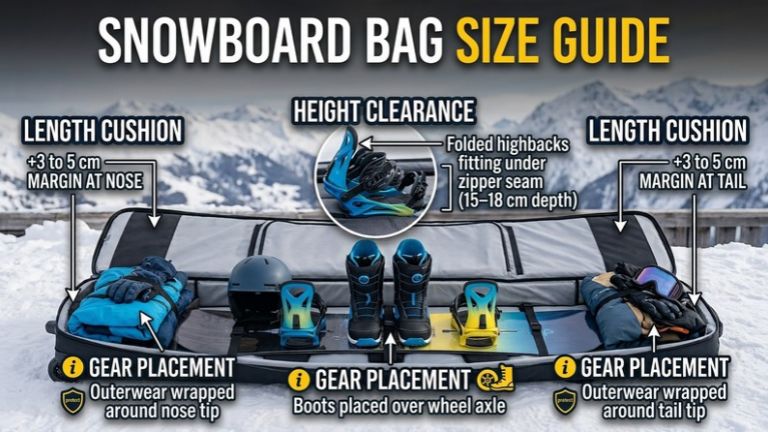
Ideal Bag Length (cm) = Longest Board Length (cm) + (3 to 5 cm)
- For Car Trips & Unpadded Sleeves: Add 2 to 3 cm to your board’s length.
- For Airline Travel & Padded Roller Bags: Add 4 to 6 cm to your board’s length. This leaves adequate clearance for padded end-caps, mounted bindings, boots, outerwear, and protective padding around the nose and tail.
Snowboard Bag Size Chart
Use this master snowboard bag size chart to match your board’s length to the recommended bag size and travel style.
| Board Length (CM) | Recommended Bag Size | Primary Bag Type | Estimated Capacity |
|---|---|---|---|
| 130 – 139 cm | 142 cm | Unpadded Sleeve / Light Padded | 1 Board + Bindings + Gloves |
| 140 – 147 cm | 150 cm | Single Padded / Light Roller | 1 Board, Boots, Outerwear |
| 148 – 155 cm | 158 cm | Padded Single / Wheeled Double | 1–2 Boards, Boots, Full Travel Gear |
| 156 – 162 cm | 165 cm | Wheeled Double Roller | 2 Boards + Boots + Outerwear + Helmet |
| 163 – 168 cm | 172 cm | Extended Double / Tour Roller | 2+ Boards, Boots, Avalanche & Powder Gear |
| 169 cm+ | 181 cm+ | Oversized Double Roller | Extended Powder/Splitboards & Heavy Equipment |
3 Critical Factors When Sizing a Snowboard Bag
When choosing a snowboard bag, measuring board length alone is not enough. You must account for padding margins, binding height, and gear volume.
1. Board Length & Padding Cushion Margin
The rated length of a snowboard bag (e.g., “157 cm”) refers to the internal room of the main compartment. However, padded bags feature heavy internal foam and reinforced plastic end-caps at the nose and tail.
If you put a 157 cm board into a 157 cm padded bag, the ends will bulge outward. Over time, airport baggage handlers throwing your bag onto conveyor belts will force the sharp metal edges of your board directly through the zipped seams. Adding a 3 to 5 cm cushion ensures the bag’s built-in padding absorbs impacts instead of your board’s edges.
2. Mounted Bindings Clearance (Bag Depth & Height)
Leaving your bindings attached to your board saves time on the mountain, but highbacks add significant vertical profile.
- Standard Bag Depth: Most quality padded single and roller bags feature a depth of 15 cm to 18 cm (6 to 7 inches).
- Pro Tip: To prevent highbacks from stretching zipper teeth, collapse your highbacks forward against the footbed and cinch down the ankle straps before sliding the board into the bag.
3. Packing Multiple Boards (Double & Triple Bags)
If you travel with a multi-board quiver (for example, an all-mountain board and a dedicated powder board), size your bag according to your longest board.
- Base-to-Base Stacking: Remove the bindings from the second board. Place the secondary board flat on the bottom of the bag, lay a protective bag liner or towel over it, and stack your primary board (with bindings mounted) directly on top.
Comparing Snowboard Bag Types
Selecting the right style of bag depends on how you travel and how much gear you plan to pack inside a single piece of luggage.
+-----------------------------------------------------------------------+
| BAG TYPE                            | BEST FOR                      | GEAR CAPACITY                               |
+-----------------------------------------------------------------------+
| Unpadded Sleeve            | Car Day Trips              | Board + Mounted Bindings          |
| Single Padded Bag          | Buses / Light Trips     | Board, Boots, Jacket                      |
| Wheeled Double Roller   | Airline Travel               | 2 Boards, Boots, Full                       |
+-----------------------------------------------------------------------+
Unpadded Board Sleeves
- Best For: Short car trips, day buses, and off-season closet storage.
- Key Features: Lightweight canvas or neoprene; minimal bulk; no wheels.
- Sizing Rule: Match closely to board length (add 1–2 cm).
Single Padded Bags
- Best For: Solo travelers taking short train or flight trips who want a lightweight option.
- Key Features: 360-degree foam padding; shoulder straps; external boot pockets.
- Sizing Rule: Add 3–4 cm to your board length.
Wheeled Double Roller Bags
- Best For: Airline travel, week-long trips, and multi-board haulers.
- Key Features: Heavy-duty urethane wheels; rigid spine rails; full padding; internal tie-down straps.
- Sizing Rule: Add 4–6 cm to your board length to maximize packing capacity for clothing and outerwear.
Brand Snowboard Bag Sizing & Dimensions
Different manufacturers measure and structure their internal bag volumes differently. Here is a quick reference for top brands:
- Dakine (e.g., High Roller, Tour Bag): Dakine builds true-to-size bags with generous end padding. A Dakine 165 cm bag comfortably accepts boards up to 162 cm while leaving end room for boots.
- Burton (e.g., Wheelie Gig, Space Sack): Burton bags feature extra vertical depth, making them ideal for high-profile step-on bindings and stiff freestyle highbacks.
- Db Journey (Douchebags – e.g., Snow Roller): Db utilizes an adjustable length-hook system. You can adjust the bag length from 100 cm up to 200 cm, making it a versatile option for both short freestyle boards and long powder guns.
(For exact dimensions, model breakdowns, and zipper specs, explore our dedicated brand-specific sizing guides linked in our resources directory).
Flying with a Snowboard Bag: Airline Rules & Packing Tips
A major benefit of a large snowboard roller bag is consolidating your gear to avoid paying extra checked-bag fees. However, you must keep airline restrictions in mind.
The 50 lbs (23 kg) Weight Threshold
Most major airlines treat a snowboard bag as one standard checked item provided it weighs under 50 lbs (23 kg).
- A heavy wheeled double roller bag weighs around 8 to 12 lbs (3.5 to 5.5 kg) empty.
- A board, bindings, and boots add another 15 to 20 lbs (7 to 9 kg).
- This leaves you with 18 to 25 lbs of allowance for outerwear, pants, helmets, and layers.
Linear Inches vs. Length
Most commercial airlines make explicit exceptions for sporting equipment length, waiving standard 62-linear-inch limits for snowboard and ski bags as long as weight rules are respected. Always verify your specific airline’s sports equipment policy prior to departure.
Smart Packing Technique
- Protect the Edges: Wrap your snowboard jacket and snow pants around the nose and tail of your board inside the bag. This provides extra protection while freeing up space in your carry-on.
- Pack Boots Separately or Centered: Place your snowboard boots in the middle of the bag over the wheel axle to maintain a balanced center of gravity while wheeling through airport terminals.
Frequently Asked Questions
Can a snowboard bag be too big?
Yes. If a bag is more than 8–10 cm longer than your board, the nose will flop around while being wheeled, causing the material to drag and scrape against pavement. If you must buy an oversized bag, fill the extra space with extra jackets or gear towels to keep the internal structure taut.
Should I get a 157 cm or 165 cm bag for a 156 cm board?
If you are buying a wheeled roller bag for airline travel, choose the 165 cm bag. The extra length gives you crucial space to pack boots, helmets, and outerwear around the board’s ends. If you are buying a lightweight sleeve for car transport, choose the 157 cm bag.
Do snowboard boots fit inside a board bag?
Yes. Padded bags and roller bags are designed with extra depth or internal boot pockets specifically to hold boots alongside your board and bindings.
Final Words on Sizing Your Bag
We hope this snowboard bag size guide helps you choose the perfect bag for your winter trips. By sticking to the Plus 3 to 5 CM Rule, choosing the right style for your transit method, and packing smart for airline weight limits, your gear will arrive at the mountain safe and ready to ride.