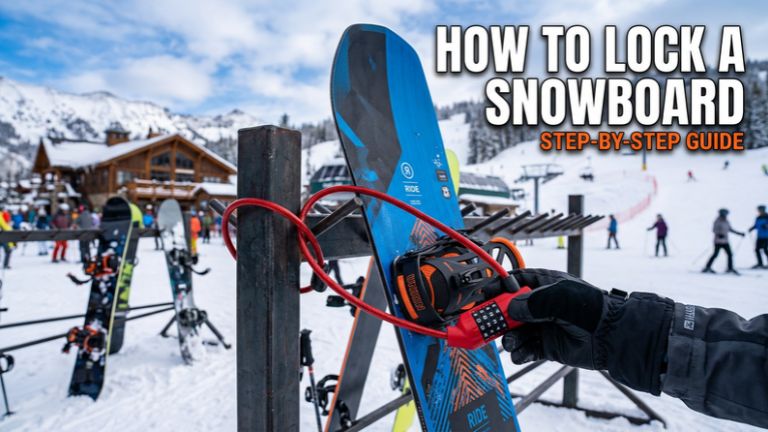
A snowboard left on a lodge rack is an easy target, and a quick lock buys you peace of mind while you grab lunch. We compared the best snowboard locks on cable length, lock type, size, and how easy they are to use with cold hands, so you can pick one that fits how you ride.


Bosvision 4-Digit Combination Lock
- 3-foot, 2.4mm vinyl-coated steel cable
- Set-your-own 4-digit code with 10,000 combinations
- Push-button retraction
- Plastic body will not scratch gear
- A cable lock deters casual theft, not a thief with cutters
- Dial can be fiddly with thick gloves
Overview
Bosvision’s retractable combination lock is a simple, lightweight lock that has become a go-to for riders who want reach, ease of use, and a low price in one package.
Key features and benefits
- 3-foot (90cm) retractable cable, 3/32 inch thick
- Vinyl-coated steel cable resists scratching
- 4-digit set-your-own combination
- Push-button retraction
- About 3.1 ounces, available in three colors
Why We Recommend It
We rank the Bosvision first because it hits the sweet spot between length and weight. A 3-foot cable is long enough to wrap around most lodge racks, ski racks, and a board with its bindings, and the lock itself weighs just over 3 ounces.
An independent roundup named it the top pick among ski and snowboard locks, praising the 2.4mm vinyl-coated cable and a plastic body that will not scratch your gear. The 4-digit code you set yourself gives you 10,000 combinations, ten times as many as a 3-digit lock.
Push-button retraction coils the cable back into the body, so there is no tangle in your pocket. Keep expectations realistic: it is a thin cable lock designed to stop opportunistic theft during a lunch break, not a determined thief.
For riders who want a light, reliable, no-key lock for everyday resort use, it is the best all-around pick.
2. Dakine Cool Lock
Dakine Cool Lock
- 37-inch self-retracting cable
- 4-digit set-your-own combination
- Bright colors make it easy to spot
- 2-year limited warranty
- Performs like the cheaper Bosvision, so you pay for the brand
- Thin cable is a deterrent rather than serious security
Overview
Dakine’s Cool Lock is a compact 4-digit cable lock with a generous 37-inch cable, built to secure your board to a roof rack in the parking lot or a rack outside the lodge.
Key features and benefits
- 37-inch (94cm) retractable cable
- 4-digit set-your-own combination
- Self-retracting design for easy storage
- Compact, pocket-sized plastic body
- 2-year limited warranty
Why We Recommend It
We include the Cool Lock because the extra reach helps. A 37-inch cable gives you a little more slack than a 3-foot cable when you are looping through a binding and a crowded rack.
An independent tester noted the Cool Lock is the same basic design as the Bosvision and M-Wave locks, with a 2.4mm vinyl-coated cable, so their performance is nearly identical. The main differences are the bright color, which makes it easy to find on a rack, and Dakine’s 2-year limited warranty.
It sells for around $30, which is more than the same design from other brands, so the choice mostly comes down to whether you value the warranty and the color.
For riders who want a trusted snow brand and a bit more cable, it is a solid, easy choice.
3. Master Lock Python 8419DPF
Master Lock Python 8419DPF
- Thick 5/16 inch (8mm) braided steel cable
- Adjustable length from 6 inches to 6 feet
- Pin tumbler key lock resists picking
- Rust-resistant lock and vinyl-coated cable
- Heavier and bulkier than the retractable locks
- Key-only, so you have to keep track of a key
Overview
Master Lock’s Python is the heavy-duty option here, a thick braided steel cable with an adjustable lock that you can cinch tight around a bike, a rack, or a snowboard.
Key features and benefits
- 6-foot cable, 5/16 inch (8mm) braided steel
- Patented adjustable lock, holds at any length
- Pin tumbler keyed lock with 2 keys
- Vinyl-coated cable and rust-resistant lock body
- Limited lifetime warranty
Why We Recommend It
We include the Python because its cable is far thicker than the others. At 5/16 inch, it is more than three times the diameter of the 2.4mm cables on the retractable locks, which makes it harder to snip with small cutters.
It is also the longest, at 6 feet. The patented adjustable lock holds the cable tight at any length from 6 inches to 6 feet, so you can lock several boards together, loop through bindings, or tie your gear to a fixed object, and the cable end threads through places other cables cannot.
The trade-offs are weight and convenience. It weighs roughly 9 ounces to nearly a pound depending on the source, it does not retract, and you need a key, so it suits car-roof and rack use better than a ski jacket pocket.
For riders who want the strongest, longest cable here for the car or a group trip, it is a dependable heavy-duty pick.
4. XCMAN Snowboard Lock
XCMAN Snowboard Lock
- 30-inch retractable cable
- Programmable 4-digit code with 10,000 combinations
- Push-button retraction
- Budget-friendly
- Very little independent testing
- Shorter cable than the 3-foot locks
Overview
XCMAN’s snowboard lock is a simple retractable cable lock with a programmable 4-digit code, sold as a low-cost option for snowboards, bikes, and luggage.
Key features and benefits
- 30-inch (76cm) retractable cable
- Programmable 4-digit combination
- 10,000 possible combinations
- Push-button retraction
- Works on snowboards, bikes, and suitcases
Why We Recommend It
We include the XCMAN as a budget alternative to the Bosvision and Dakine. It offers the same convenient format, a retractable cable and a 4-digit code you can change as often as you like, at a lower price.
The 30-inch cable is long enough to loop through a binding and a single rack bar, though it is shorter than the 3-foot locks, so it is less flexible on wide or crowded racks.
For riders who want a simple, inexpensive retractable lock for short stops, it is a reasonable choice.
5. ABUS Combiflex StopOver
ABUS Combiflex StopOver
- Pocket-sized, only 46 grams
- Self-retracting cable
- User-settable number code
- Backed by a well-known security brand
- Thin cable, security level listed as low
- Short 65 cm length limits what you can lock to
Overview
ABUS built the Combiflex StopOver as a tiny, roll-back cable lock for short stops, small enough to disappear into a jacket pocket.
Key features and benefits
- 65 cm self-retracting cable
- Weighs 46 grams
- User-settable and changeable number code
- Compact pocket format
- Designed to deter casual and opportunistic theft
Why We Recommend It
We include the StopOver for riders who want the lightest possible lock. At only 46 grams, it weighs about a third of the Dakine Cool Lock, and the cable rolls back in automatically after you enter your code.
ABUS markets it for skis, snowboards, helmets, and luggage during excursions and short stops. Be honest about what it offers: retail specs list a thin cable of about 1.2mm and a low security level, so it is a visual deterrent rather than serious protection.
The 65 cm length is also short, so it works best looped through a binding and a single rack bar rather than wrapped around a crowded rack. ABUS sells longer versions, so check the size on your listing.
For riders who want a featherweight lock they will actually carry, it is a neat, well-made minimalist option.
6. Dakine Micro Lock
Dakine Micro Lock
- Tiny 3 by 2 by 0.75 inch body weighing 1.7 ounces
- 30-inch retractable cable
- Set-your-own 3-digit combination
- 2-year limited warranty
- Only 1,000 possible combinations with a 3-digit code
- A tester found the shorter cable hard to use on many racks
Overview
Dakine’s Micro Lock is the little sibling of the Cool Lock, a pocket-friendly 3-digit lock that is strong enough to keep a casual thief from walking off with your gear.
Key features and benefits
- Compact 3-digit combination lock
- 30-inch (76cm) retractable cable
- Set your own combination
- Plastic body with a urethane-coated steel cable
- 2-year limited warranty
Why We Recommend It
We include the Micro Lock for riders who care most about size. At 1.7 ounces and roughly the size of a deck of cards, it tucks into a pocket and weighs less than half of the larger Cool Lock.
Dakine says it uses the same materials as the Cool Lock, with a retractable cable and a set-your-own code. At around $15, it is also one of the cheapest options here.
The compromise is reach. One independent tester found the shorter cable not long enough for many ski racks, and a 3-digit code gives only 1,000 combinations, so it is the least secure lock on this list.
For riders who only need to loop a board to a nearby fixture and want the smallest lock possible, it is a convenient pocket option.
Snowboard Lock Buyer’s Guide
Seven features separate a useful lock from one that stays in the bag. Compare them before you choose.
Security and Theft Resistance
Look at how well the lock resists tampering and casual theft. A tougher cable and a solid locking mechanism make a thief’s job harder and slower.
Be realistic, though. No portable snowboard lock is completely theft-proof. A determined thief with the right tools can cut most cable locks. The goal is to deter quick, opportunistic theft and make your board a less attractive target than the one next to it.
Lock Type: Combination vs. Keyed
Combination locks do not need a key, so there is nothing to lose in the snow. You set a code and remember it. They are convenient, but you need to be able to read and turn the dial.
Keyed locks use a traditional mechanism and may suit riders who prefer that feel. The downside is carrying a key, which is easy to drop or lose on the mountain. Keep it zipped in a secure pocket.
Cable Length and Thickness
Cable length decides what you can lock to. You need enough cable to loop through the board’s binding or a gap and around the rack. Many cable locks run about 3 to 6 feet (roughly 1 to 2 meters), though models vary. A longer cable gives you more flexibility, but it also adds bulk.
Thickness matters too. A thicker cable resists cutting better, but it weighs more and takes more space. A thinner cable is easier to carry but offers less resistance. Pick a balance that fits how you travel.
Portability and Weight
A lock only helps if you actually carry it. Check whether it fits in a jacket pocket or a backpack without becoming a hassle. Lighter, coiled designs pack down easily. Heavy chains can feel like a burden after a few hours.
Ease of Use With Gloves
Cold hands and thick gloves make small dials hard to read. Look for large, clearly marked numbers and dials that turn smoothly. Check how easy it is to set or change the combination, since you may want to do that before the season starts.
Try the lock with your own gloves on before you rely on it. If you cannot work it comfortably in the store, you will not enjoy using it at the mountain.
Weather Resistance and Durability
Snow, moisture, and freezing temperatures take a toll on locks. Look for corrosion-resistant materials, such as coated steel or stainless components, and a mechanism that can handle cold and wet conditions. A lock that sticks or freezes at the wrong time is no help.
After a wet day, wipe the lock dry and let it air out. Avoid leaving it frozen in a bag overnight.
Compatibility With Snowboard Racks
Resort racks vary. Some are narrow slots, others are bars or posts. Before you buy, check whether the cable or locking mechanism can secure a board to the racks you usually see.
Make sure the cable can pass through or around the board and the rack at the same time. Think about where you will thread it, such as through a binding or around the base of the board. Look at photos of your local mountain’s racks, or ask the resort, if you are unsure.
Final Thoughts
Choosing from the best snowboard locks is about trading security for convenience. The Bosvision and Dakine Cool Lock give you the best balance of length, weight, and a 4-digit code, while the Master Lock Python is the toughest and longest for the car or a group trip.
The XCMAN is a budget retractable alternative, and the ABUS Combiflex and Dakine Micro Lock are the smallest, lightest options for riders who value pocket space. All six are cable locks, so think of them as a deterrent rather than a guarantee.
Whichever lock you pick, loop it through your bindings and around a fixed rack, and lock your board where you can see it. A board secured at eye level is much less likely to disappear than one left in a pile.
Can a snowboard lock stop a determined thief?
No. These are cable locks, and a thin cable can be cut with a pair of cutters. They deter casual and opportunistic theft during short stops, so for longer stays take your board inside or use a thicker cable like the Master Lock Python.
Where should I lock my snowboard?
Loop the cable through your bindings and around a fixed rack or post, preferably where you can see it from the lodge. Locking only to the board itself offers little protection, since a thief could carry it off.
How long should the cable be?
Around 3 feet works for most lodge and roof racks. An independent tester found a shorter cable, such as the Dakine Micro Lock’s, hard to use on many racks, while the Master Lock Python reaches 6 feet.
Is a combination lock or a key lock better?
Combination locks, like the Bosvision and Dakine, have no key to lose and let you set your own code. A key lock, like the Master Lock Python, uses a pin tumbler mechanism that resists picking but needs a key to carry.
How many combinations does a lock have?
A 4-digit lock, like the Bosvision, XCMAN, and Dakine Cool Lock, has 10,000 possible codes, while a 3-digit lock, like the Dakine Micro Lock, has 1,000. More digits make guessing harder.
Will a cable lock scratch my board?
Most of these use a vinyl or urethane-coated cable and a plastic body, which are designed not to scratch your gear. The Master Lock Python also has a vinyl-coated cable.
Can I use these locks for skis, bikes, and luggage too?
Yes. Most are sold for snowboards, skis, bikes, strollers, and luggage, and ABUS markets the Combiflex for skis, snowboards, helmets, and luggage.
How do I keep a combination lock from freezing?
Keep it in an inside pocket when you are not using it, wipe off snow and moisture before you set the code, and do not store it wet. Cold and ice can make the dial stiff.