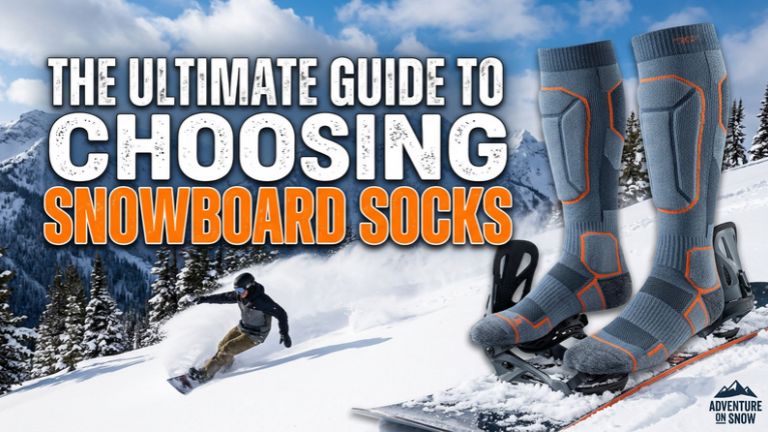
When dialing in your snowboard setup, most riders spend endless hours researching board flex profiles, boot lacing systems, and binding responsiveness. However, a single overlooked piece of gear often makes or breaks a day on the mountain: your socks.
Snowboard boots are rigid, highly technical performance shells designed to fit down to the millimeter. Wearing the wrong pair of socks undermines even the most expensive boot setup, leading to agonizing foot cramps, frozen toes, blistered heels, and lost control on edge.
This guide breaks down everything you need to know about choosing the perfect pair of snowboard socks, covering key factors such as height, thickness, material blends, compression benefits, and brand comparisons.
How Important Are Snowboard Socks?
If you ask seasoned riders whether specialized snowboard socks matter, the consensus is unanimous: they are just as critical as your boots.
Your socks represent the primary interface between your body and your boot’s internal liner. When you initiate a toe-side turn or press into a heel-side carve, energy transfers directly from your shin, ankle, and foot through the sock into the boot.
If your sock bunches, retains moisture, or lacks elastic retention, that energy transfer breaks down, resulting in:
- Boot Slop: Movement inside the liner that delays edge responsiveness.
- Friction Blisters: Loose material rubbing against skin under high pressure.
- Circulation Blockage: Extra fabric volume cutting off blood flow in tight boot shells.
Do You Need Special Socks for Snowboarding?
Yes, absolutely. Everyday athletic socks, tube socks, or casual trainer socks are engineered for low-top street shoes in roomier environments. They lack the structural zones required for snowboard boots.
Snowboard-specific socks feature engineered tension zones around the arch and ankle to prevent sagging, targeted high-density padding across the shin to absorb boot-tongue pressure, and flat-stitched toe seams that lie flush against the toes under heavy forward lean.
Are Snowboard Socks Worth It?
Without a doubt. Spending $20 to $35 on a pair of high-performance snowboard socks protects your $300 to $600 boot investment.
A quality pair of snowboard socks lasts multiple seasons, actively prevents “shin bite” (painful tissue inflammation along the tibia caused by boot pressure), keeps your feet dry through advanced moisture-wicking fibers, and eliminates cold toes by preserving healthy blood circulation.
Snowboard Socks vs Regular Socks
To understand why everyday socks fail inside a snowboard boot, consider how different their construction and materials are:
| Feature | Snowboard Socks | Regular Everyday Socks |
| Primary Materials | Technical Merino wool, Nylon, Elastane, Polypropylene | Cotton, basic cotton-poly blends |
| Moisture Handling | Hydrophobic & moisture-wicking; pulls sweat away from skin | Hydrophilic; absorbs and holds moisture like a sponge |
| Cut & Height | Over-the-Calf (OTC); sits safely above boot cuff | Ankle, quarter, or mid-crew length |
| Elastic Retention | Anatomical arch/ankle bands to prevent slipping or bunching | Generic stretch; easily sags and slips down during movement |
| Padding Distribution | Strategic shin, heel, and toe box density; flat instep | Uniform thickness or thick bottom terry loop |
| Toe Construction | Seamless/flat-stitched toe box | Bulky, raised toe seams that pinch under pressure |
The Danger of Cotton
The golden rule of winter sports is simple: never wear cotton.
Cotton fibers are hydrophilic, which means they absorb up to 27 times their weight in moisture. When your feet sweat inside your boot liner, cotton socks soak up that dampness and hold it directly against your skin. Because damp fabric conducts heat away from the body 25 times faster than dry air, wet cotton socks rapidly freeze your feet even inside insulated boots and dramatically accelerate blister formation through increased friction.
How High Should Snowboard Socks Be?
Snowboard socks must be Over-the-Calf (OTC), extending completely above the top cuff of your inner boot liner and outer boot shell.
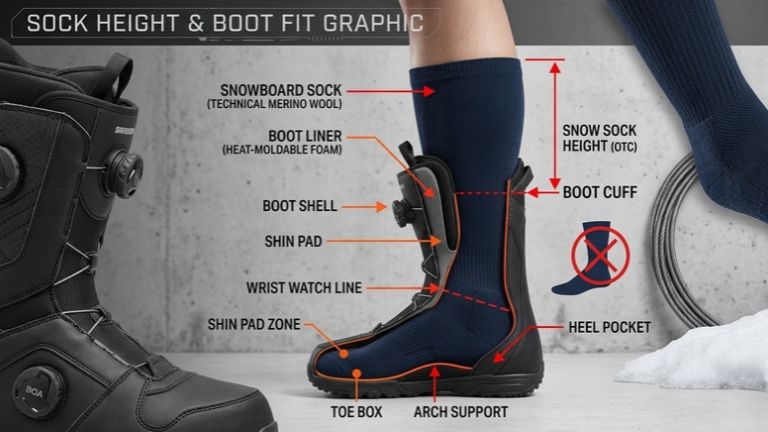
Why Over-the-Calf Height is Non-Negotiable
- Prevents Severe Boot Chafing: If a sock ends below or level with the top of the boot liner (like a crew sock), the rigid cuff of the liner rubs directly against your skin with every flex and turn. This causes severe friction burns within a few runs.
- Eliminates Pressure Ridges: The top band of any sock has elastic tension. If that band sits inside the boot, the squeezed boot liner presses the elastic ring directly into your calf muscle or Achilles tendon, cutting off circulation and causing intense cramping.
- Stays Up All Day: Over-the-calf socks use the widest part of your calf muscle as an anchor, preventing the sock from sliding down into the heel pocket.
Crucial Rule: Never wear two pairs of socks or fold your socks over the top of your boot. Layering socks creates friction layers that generate painful blisters, restricts circulation, and creates uncomfortable bunching.
How Thick Should Snowboard Socks Be?
One of the most persistent myths in winter sports is that thicker socks mean warmer feet. In modern snowboarding, thinner is almost always better.
Modern snowboard boot liners are packed with thermal insulation (such as Thinsulate or heat-moldable EVA foam). Boots are engineered to fit snugly around your foot shape to maximize board control. Adding a thick, bulky sock inside a properly fitted boot creates extreme pressure, compresses your foot, and restricts blood flow, which actually causes your toes to freeze..
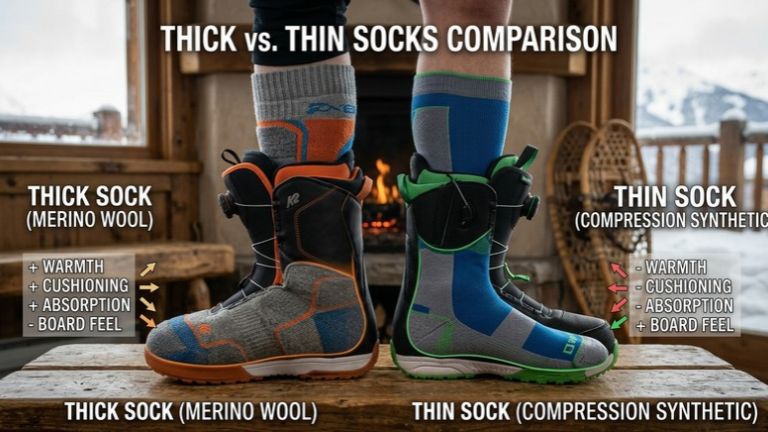
Thick or Thin Socks for Snowboarding (Plus Ultra-Thin)
1. Thick / Midweight Socks
- Best Used For: Sub-zero deep winter riding, or breathing new life into old, packed-out boot liners that have developed extra internal volume over time.
- Pros: Extra impact absorption along the sole; fills unwanted gap space in older boots.
- Cons: Prone to crowding the toe box in new or properly fitted boots, restricting blood flow and causing cold, numb toes.
2. Thin / Lightweight Socks (The Standard Recommendation)
- Best Used For: 80% to 90% of all snowboarders across all conditions.
- Pros: Strikes the ideal balance of warmth, breathability, and padding. Features targeted shin density without adding unnecessary bulk inside the foot bed.
- Cons: None for standard riding setups.
3. Ultra-Thin / Ultralight Socks
- Best Used For: Performance riders, park carvers, splitboarders, or boots with custom heat-molded liners.
- Pros: Eliminates all play between your foot and boot for instant edge response. Allows maximum space inside the liner so blood flows freely to keep toes warm naturally. Sweat evaporates rapidly due to minimal fabric density.
- Cons: Provides minimal padding for riders with sensitive shins or foot pain.
Are Wool Socks Good for Snowboarding?
Yes, but specifically fine Merino wool, not traditional, scratchy coarse wool.
Merino wool, harvested from Merino sheep, is widely regarded as the ultimate natural fiber for technical winter apparel. Unlike traditional wool, Merino fibers are ultra-fine (micron counts under 21), making them silky-smooth against the skin and completely itch-free.
MERINO WOOL HIGHLIGHTS
├── Thermal Regulation (Traps micro-air pockets for warmth)
├── Active Moisture Management (Wicks vapor before it turns to liquid sweat)
├── Natural Odor Resistance (Lanolin prevents bacterial growth)
└── Wet-Warmth Retention (Insulates even when damp)
Why Merino Wool Dominates
- Thermoregulation: Merino wool fibers naturally react to body temperature changes. They trap micro-air pockets when cold and release warmth and moisture during intense spring riding.
- Wicks Vapor Before it Liquefies: Synthetic fibers wait for sweat to turn into liquid before wicking it away. Merino wool absorbs moisture vapor directly into its core before releasing it outside the sock, keeping your skin dry longer.
- Natural Odor Control: Merino wool contains natural antimicrobial properties (lanolin) that prevent odor-causing bacteria from taking hold. This makes Merino socks ideal for multi-day trips where washing gear daily isn’t an option.
The Ideal Blend
While 100% Merino wool sounds appealing, pure wool lacks the elastic recovery and abrasion resistance needed for snowboarding. Look for socks with a technical blend:
- 40%–65% Merino Wool: For warmth, moisture management, and odor resistance.
- 30%–50% Nylon / Polyamide: For structural durability in high-wear zones (heel and toe).
- 2%–5% Elastane / Lycra: For stretch, contouring, and long-term shape retention.
Specialty Features & Brand Performance
Beyond height and thickness, modern technical socks incorporate advanced features designed to enhance riding endurance and boot fit.
Are Compression Socks Good for Snowboarding?
Yes, graduated compression socks offer clear medical and athletic advantages on the slopes:
- Enhanced Circulation: Graduated compression applies the firmest pressure at the ankle and gradually decreases pressure moving up the calf. This venous assist pushes oxygen-depleted blood back up toward the heart, preventing blood pooling and keeping warm blood circulating into your toes.
- Reduced Muscle Fatigue: Snowboarding subjects your calf muscles and shins to constant micro-vibrations when riding over chunder, icy groomers, or uneven terrain. Compression reduces muscle oscillation, cutting down on muscle fatigue and delayed onset muscle soreness (DOMS).
- Zero-Slide Fit: Compression fabrics grip the lower leg like a second skin, guaranteeing the sock never sags, slips, or bunches inside the boot liner during hard carving.
Are Stance Socks Good for Snowboarding?
Yes, Stance is one of the premier brands in snowboarding gear.
Stance built its reputation by redesigning traditional snow socks around anatomical performance and targeted durability:
- Anatomical Mapping: Stance snow socks are knit specifically for the left and right foot (indicated by “L” and “R” markers), ensuring the padding lines up precisely with the unique contours of each foot.
- Infiknit™ Technology: High-wear impact zones—specifically the toe box and heel pocket—are reinforced with specialized high-density nylon filaments to prevent blowout holes.
- FEEL360™ / FreshTek™ Treatment: Stance applies fiber treatments that accelerate moisture evaporation and eliminate odor-causing bacteria.
- Versatile Range: Stance offers options across the spectrum, from their Ultra-Light Wool (designed for tight-fitting performance boots) to midweight cushioned models for extra impact protection in the park.
How to Diagnose and Fix Common Boot & Sock Issues
If you experience foot pain or temperature issues while riding, use this quick troubleshooting guide to adjust your sock choice:
Issue 1: Cold, Numb Toes
- Likely Cause: Your socks are too thick, or your boot lacing is squeezed too tight across the instep, restricting blood circulation.
- The Fix: Switch to a thin or ultra-thin Merino wool sock. Ensure your toes can wiggle freely inside the boot box.
Issue 2: Shin Bite (Pain along the front of your shins)
- Likely Cause: Your socks are bunching up, or your boot tongue is rubbing against bare skin due to short sock height. Alternatively, your boots may be too loose, causing your shin to bang against the tongue.
- The Fix: Wear a dedicated Over-the-Calf sock with targeted shin cushioning, and ensure your boot’s upper speed-lacing or Boa dial is tightened securely.
Issue 3: Heel Lift & Blisters
- Likely Cause: Excess moisture build-up from cotton or low-grade synthetic socks, or a sock that is sliding down inside the liner.
- The Fix: Switch to an anatomical, moisture-wicking Merino wool sock with arch/ankle elastic support bands. If boot liners are old and packed out, move up from an ultralight sock to a light/medium cushioned sock to fill space.
Summary & Buyer’s Checklist
Before heading to the shop or ordering your next pair online, run through this quick checklist to ensure you get the right sock:
┌─────────────────────────────────────────────────────────────┐
│                 SNOWBOARD SOCK BUYER'S CHECKLIST                                                                           │
├─────────────────────────────────────────────────────────────┤
│ [ ] Height: Over-the-Calf (OTC) only                                                                                               │
│ [ ] Material: Merino Wool blend (Avoid 100% Cotton)                                                                   │
│ [ ] Thickness: Thin to Ultralight for modern, snug boots                                                              │
│ [ ] Fit: Snug & anatomical with arch/ankle support                                                                     │
│ [ ] Construction: Flat-stitched seamless toe box                                                                         │
└─────────────────────────────────────────────────────────────┘
By investing in two or three pairs of high-quality, over-the-calf Merino wool or technical synthetic socks, you’ll protect your feet, extend the life of your boots, and stay warm and comfortable from first chair to last lap.
Now that you know how to evaluate height, thickness, and materials, you are ready to find your ideal pair. Check out our detailed guide to the best snowboard socks to see which specific models top our list for warmth, durability, and boot performance this season.