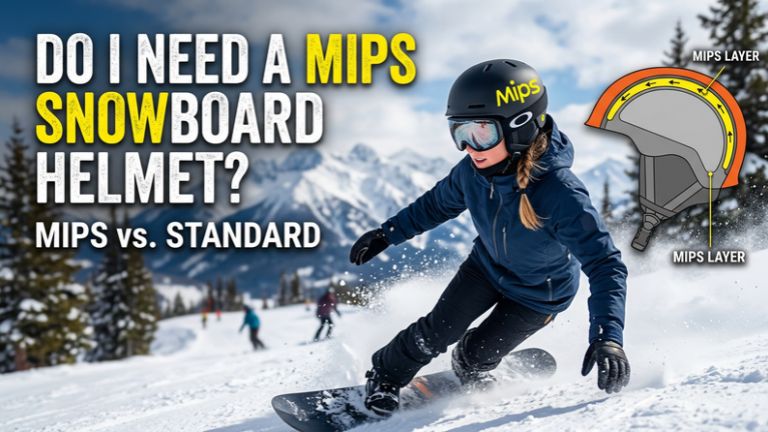
Not strictly, but it’s worth prioritizing once a helmet already fits well and carries a real safety certification. MIPS solves a specific problem, angled impacts, rather than impacts in general, and skipping it on a properly certified helmet is a far smaller risk than buying a MIPS helmet that doesn’t fit right or was never certified to begin with.
What MIPS Actually Does
MIPS stands for Multi-Directional Impact Protection System: a low-friction layer inside the helmet that lets the inner liner rotate slightly against the outer shell during an angled impact, which reduces the rotational force that reaches your head.
Angled impacts, hitting the snow at an angle rather than straight on, are the common case in a snowboarding fall rather than the exception, which is why the feature exists for this sport specifically rather than being a general add-on.
Koroyd is a different technology entirely, a crushable honeycomb structure that absorbs straight-on impact energy, and some premium helmets run both MIPS and Koroyd together because they address two separate kinds of force rather than competing versions of the same fix.
Neither one replaces the other, and a helmet with Koroyd but no MIPS, or the reverse, isn’t missing a corner that was cut so much as covering one problem and not the other.
Is MIPS necessary for Snowboard Helmet
MIPS is not strictly necessary for a snowboard helmet, but it can be a worthwhile safety feature. MIPS, or Multi-directional Impact Protection System, is designed to help reduce rotational forces that can occur during certain angled impacts.
Since snowboard falls often involve unexpected contact with the snow or terrain, some riders may prefer a helmet with MIPS for the additional protection it is designed to provide.
That said, a helmet without MIPS can still provide important protection, and choosing a properly fitted, certified snowboard helmet should come first.
If you are deciding between two helmets that fit equally well and have comparable safety certifications, choosing the MIPS model can make sense if the added technology and cost work for you.
MIPS is best viewed as an additional safety feature rather than a requirement for every snowboarder.
Certification Comes Before MIPS, Not After
Every helmet worth buying needs ASTM F2040 certification in the US, or CE EN 1077 in Europe, before anything else about it matters.
That baseline certification is what guarantees a helmet actually absorbs a direct impact the way it’s supposed to, and it’s consistent across the entire price range: a budget helmet and a premium one that both carry it protect your head equally well in a straight-on fall.
MIPS is a layer on top of that baseline, addressing a specific force the certification test doesn’t isolate, not a replacement for it.
A helmet that fits properly and is certified but has no MIPS is a safer choice than a MIPS helmet that sits loosely or rides up over your eyes, because a poor fit undermines everything the shell and foam are built to do.
Where MIPS Sits in the Price Tiers
Snowboard helmets generally run from around 60 dollars at the budget end to 300 dollars or more at the premium end, with most riders landing on something solid in the 100 to 180 dollar middle.
MIPS shows up inconsistently through that middle tier and becomes close to standard once you’re above roughly 180 dollars, which is also where it usually gets paired with a second technology like Koroyd rather than offered alone.
The jump in price between an otherwise comparable helmet with MIPS and one without tends to be modest rather than dramatic, closer to the gap between a mid-tier and a slightly-nicer mid-tier helmet than the gap between budget and premium.
That’s the actual case for prioritizing it: not that it transforms an unsafe helmet into a safe one, but that the added protection costs relatively little once you’re already shopping in that range.
When Skipping MIPS Makes Sense
An occasional rider who gets out a handful of days a season and is choosing between a certified budget-tier helmet and stretching into the mid tier for one with MIPS is better served putting that money toward a helmet that actually fits, or toward boots and bindings that are further from the end of their usable life.
The benefit MIPS offers is real but narrow, and a casual rider who rarely pushes into terrain or speed where a bad angled fall is likely gets diminishing value from paying for it compared to someone riding aggressively or frequently enough that the odds catch up.
Frequent riders, and anyone who’s already comparing two similarly priced, similarly fitting helmets where one happens to include MIPS, don’t have that tradeoff to make: at that point it’s the better pick with no real downside attached.
Our full helmet buying guide breaks down specific models across that entire price range if certification and fit are the pieces still unresolved.