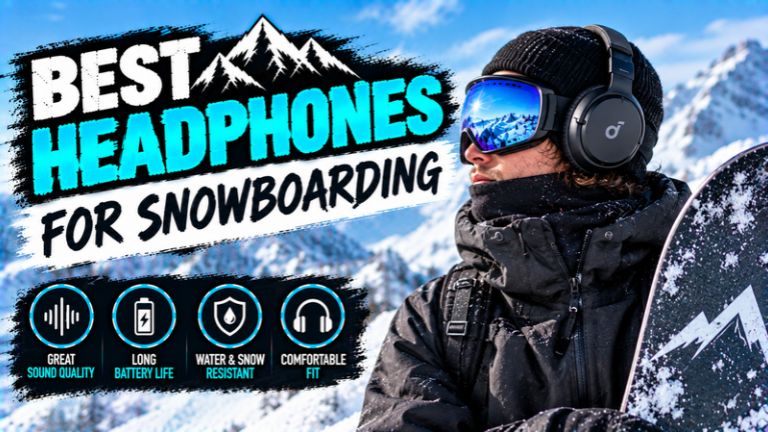
A good playlist makes lift rides shorter and long groomers feel faster, but the wrong headphones are cold, bulky, and a pain under a helmet. We compared the best headphones for snowboarding on fit, battery life, cold-weather performance, and how easy they are to run with gloves on.


Origem Wireless Snowboard Headphones
- Bluetooth 6.0 for a stable connection
- 40mm drivers with HDR audio
- Quick charge, with a case that extends total battery to about 40 hours
- Glove-friendly buttons
- Only works with audio-ready helmets
- Newer brand with less track record than Outdoor Tech or Aleck
Overview
Origem’s helmet speakers are true wireless drop-ins, small speakers that slip into the ear pads of an audio-ready helmet and stream music, calls, and voice commands from your phone.
Key features and benefits
- True wireless drop-in design
- 40mm drivers with HDR audio
- Bluetooth 6.0, 10 meter range
- About 10 hours of playback, 15-minute quick charge
- Charging case and glove-friendly buttons
Why We Recommend It
We rank the Origem first because it combines the newest wireless tech with the most practical battery setup. Bluetooth 6.0 gives it a steady connection, and one independent roundup named it the top pick for most skiers and boarders.
Each speaker runs about 10 hours, and the charging case brings the total to roughly 40 hours, which covers a full weekend trip without a wall outlet. A 15-minute quick charge adds meaningful playtime between sessions.
The 40mm hybrid drivers and HDR audio processing are tuned to sound fuller than the tiny speakers in many drop-ins, and the buttons are laid out to work with gloves. Reviewers noted they stay usable in subzero conditions.
For riders who already own an audio-ready helmet and want the most up-to-date drop-in speakers, it is the strongest pick on the list.
2. Outdoor Tech Chips Ultra 2.0
Outdoor Tech Chips Ultra 2.0
- Fully wireless pucks with no cord between them
- 40mm drivers in a slim profile
- 12 to 13 hours per charge, about 36 hours with the case
- Glove-friendly controls, mic, and Siri or Google access
- Priced higher than most drop-ins
- Needs an audio-ready helmet
Overview
Outdoor Tech is one of the best-known names in helmet audio, and the Chips Ultra 2.0 is its fully wireless version, with no cord connecting the left and right speakers.
Key features and benefits
- Completely true wireless pucks
- 40mm drivers
- 12 to 13 hours of play per charge
- USB-C charging case with about 36 hours total
- Simple button combinations for music, calls, and voice assistants
Why We Recommend It
We include the Chips Ultra 2.0 because Outdoor Tech is the brand most helmet audio is measured against. Its flat, slim speakers fit most helmet ear pouches and are described as barely noticeable once in place.
Going cord-free means you can pull a speaker out without tugging a wire, and the charging case adds roughly three full charges on the go. One owner said the buttons are easy to find through the ear pads, even with heavy gloves.
If you do not need cord-free speakers, the cheaper Chips 3.0 gives you 13 hours, Bluetooth 5.2, and a 45-minute charge, and independent testers ranked it among the best ski helmet speakers.
For riders who want a proven brand, a slim fit, and a case, this is a polished, premium pick.
3. Aleck 006 Helmet Headphones
Aleck 006 Helmet Headphones
- 40mm drivers with Bluetooth 5
- Oversized glove-friendly buttons
- Built-in mic with Siri and Google Assistant
- Works with Smith, POC, Giro, and other audio-ready helmets
- Battery is about 10 hours on most listings
- Older versions use a micro USB charging port
Overview
Aleck makes the audio systems used inside Smith’s helmets, and the 006 is its universal drop-in speaker for audio-ready ski and snowboard helmets.
Key features and benefits
- 40mm drivers, low-profile puck design
- Bluetooth 5, hands-free mic
- Oversized buttons for gloved hands
- Siri and Google Assistant access
- Universal fit for most audio-ready helmets
Why We Recommend It
We include the Aleck 006 because it is one of the most widely used helmet audio products. Reviewers praise the dynamic 40mm drivers for balanced sound with deep bass, and the large buttons are easy to press through a glove.
The built-in microphone lets you take calls and use Siri or Google Assistant without taking your gloves off. It fits Smith, POC, Giro, and many other audio-ready helmets, and the thin 14mm profile means it does not crowd your ears.
Battery life is listed at about 10 hours on most versions, with newer versions listing up to 18 hours, so check the exact listing. Some versions also include a push-to-talk walkie-talkie feature for talking to a friend with a matching unit.
For riders who want a dependable, well-known drop-in with simple, glove-friendly controls, it is a safe choice.
4. Wildhorn Alta Wireless Headphones
Wildhorn Alta Wireless Headphones
- Tested in cold down to minus 4°F
- IP45 water and sweat resistance
- Fits Smith, POC, K2, Giro, Bolle, Anon, Burton, and Wildhorn helmets
- Compact 2.2 by 1.8 by 0.5 inch design
- Battery claims vary from 10 to 17 hours by source
- Older charging port design
Overview
Wildhorn’s Alta is a rugged set of drop-in speakers made for snow helmets and tested in extreme cold, with 40mm drivers and glove-friendly controls.
Key features and benefits
- 40mm drivers and Bluetooth 5.0
- Tested to minus 4°F (minus 20°C)
- IP45 water, sweat, and cold resistance
- Glove-friendly controls and built-in mic
- Siri and Google Assistant compatible
Why We Recommend It
We include the Alta because it is built for real cold. Wildhorn says the speakers were tested in extreme cold to minus 4°F, and the IP45 rating covers sweat and splashes, which matters when your helmet is wet from snow.
The brand lists compatibility with helmets from Smith, POC, K2, Giro, Bolle, Anon, Burton, and Wildhorn, and the small puck shape drops right into the ear pad. Controls work with gloves on, and a built-in mic handles calls and voice assistants.
Battery claims vary. Wildhorn’s own site lists 10 or more hours, while the Amazon listing cites up to 17. One owner reported getting more than two days of skiing between charges.
For riders who want a tough, cold-tested drop-in from a snow-focused brand, it is a reliable pick.
5. OutdoorMaster Snow-BT01
OutdoorMaster Snow-BT01
- Up to 15 hours of playtime
- IP45 sweat and water resistance
- Tested to minus 4°F (minus 20°C)
- Glove-friendly buttons and built-in mic
- Bluetooth version is listed differently across sources
- Less premium sound than higher-priced picks
Overview
OutdoorMaster’s BT01 is a budget-friendly pair of drop-in speakers with a long battery and a short charging cord that lets you top them up without removing them from your helmet.
Key features and benefits
- 40mm drivers and Bluetooth
- Up to 15 hours of playtime
- IP45 sweat and water resistance
- Tested to minus 4°F (minus 20°C)
- Built-in mic and glove-friendly buttons
Why We Recommend It
We include the BT01 as the value pick. Multiple independent roundups call it the best value under about $50, and it still delivers 15 hours of playtime, longer than most drop-ins.
It fits most ski and snowboard helmets, and OutdoorMaster says it also works in motorcycle helmets. A built-in microphone handles calls, and testers noted clear highs, big bass, and a stable connection.
A short cord lets you charge the speakers while they stay in your helmet, which is a nice convenience on a long trip.
For riders who want long battery life and solid features without a premium price, it is a smart, practical choice.
6. Shokz OpenRun Pro 2
Shokz OpenRun Pro 2
- Open-ear bone conduction keeps you aware of your surroundings
- Bluetooth 5.3 and up to 12 hours of battery
- IP55 sweat and water resistance
- Quick charge gives 2.5 hours from 5 minutes
- Not a helmet drop-in, so check helmet and beanie fit
- Priced around $180
Overview
Shokz pioneered bone conduction headphones, and the OpenRun Pro 2 adds a conventional air conduction driver for fuller bass, all while leaving your ears open.
Key features and benefits
- DualPitch bone and air conduction drivers
- Open-ear design leaves ears uncovered
- Bluetooth 5.3, up to 12 hours of play
- IP55 rating, USB-C charging
- Titanium memory alloy neckband
Why We Recommend It
We include the OpenRun Pro 2 for riders who want to stay aware of the mountain. Because the sound comes through your cheekbones, your ears stay open to hear other riders, lift announcements, and changes in snow noise.
Independent reviewers call it the best all-around bone conduction headphone, with better bass than older models, a secure fit, and 12 hours of battery. The IP55 rating handles sweat and splashes, though Shokz notes it is not meant for submersion.
It is not made for helmets. The band wraps behind your head, so check that it sits comfortably under your helmet and any beanie before relying on it for a full day.
For riders who prioritize awareness or do not have an audio-ready helmet, it is an excellent alternative.
7. JBL Tune 125BT
JBL Tune 125BT
- Up to 16 hours of playback
- Affordable, around $45
- Magnetic earbuds and a flat tangle-free cable
- Three-button remote with a mic
- No water-resistance rating listed
- In-ear fit blocks outside sound, so keep the volume low
Overview
JBL’s Tune 125BT is a simple neckband earbud with JBL’s Pure Bass sound and a long battery, a low-cost option for riders without audio-ready helmets.
Key features and benefits
- 8.6mm drivers with JBL Pure Bass Sound
- Bluetooth 5.0, multipoint connection
- Up to 16 hours of playback
- USB-C charging, 15 minutes for 1 hour of audio
- Three-button remote with a built-in mic
Why We Recommend It
We include the Tune 125BT because it is the cheapest, easiest way to get music on the hill without a special helmet. The earbuds sit in your ears and the flat cable runs behind your neck, so they are quiet and fit under a beanie or most helmets.
Battery life is up to 16 hours, a 15-minute charge gives you an hour of playback, and a three-button remote with a mic handles volume, calls, and voice assistants. They weigh only about 0.6 ounces.
They are not made for snow. There is no water-resistance rating, and in-ear designs block outside sound, so keep the volume low enough to hear other riders around you.
For riders on a tight budget who want simple wireless audio, it is a reasonable starter pair.
8. JVC HA-S23W Wireless Headphones
JVC HA-S23W Wireless Headphones
- 17-hour battery
- Flat-folding, lightweight design
- Bluetooth 5.0 with a 3-button remote and mic
- Affordable
- On-ear design will not fit under most snow helmets
- No weather or water-resistance rating
Overview
JVC’s HA-S23W is a lightweight, foldable on-ear headphone with a long battery, best suited to the lodge, the drive, and the trip home rather than the lift.
Key features and benefits
- 30mm drivers, Bluetooth 5.0
- 17-hour battery
- Flat foldable swivel design
- 3-button remote with a built-in mic
- Voice assistant compatible
Why We Recommend It
We include the HA-S23W as the honest outlier. It is a good everyday headphone with a long battery, a lightweight build, and a flat-folding design that packs into a pocket or boot bag.
On the mountain, however, an on-ear band will not fit under most helmets, and there is no water-resistance rating. It makes more sense for the lodge, the car, or a day when you are not wearing a helmet.
It charges in about 3 hours over micro USB and has a range of roughly 33 feet.
For riders who want a low-cost pair for the trip around the snowboarding, but not for the hill itself, it is a sensible extra.
Buyer’s Guide
1. Helmet Compatibility and Fit
Start with your helmet. Look for low-profile designs or helmet-compatible audio systems made to sit inside the ear pads. Check that the headphones fit comfortably under the pads without creating pressure points. A bulky speaker pressing on your ear gets painful after an hour.
2. Sound Quality
Look for clear, balanced sound with enough bass to feel full. Wind noise makes music harder to hear outdoors, so volume performance matters. But loudness alone is not the goal. On a busy slope, you need to stay aware of other riders and warnings. Good clarity at moderate volume beats high volume with muddy sound.
3. Battery Life
Long days need long battery life. Many models list roughly 6 to 12 hours of playback, though this varies a lot. Cold weather reduces battery performance, so manufacturer estimates may not match real winter use. Charge your headphones before you go, and keep them warm in an inner pocket between runs when you can.
4. Water and Weather Resistance
Water resistant and waterproof are not the same. Water resistant means protection from splashes and light moisture. Waterproof means the device can handle a defined level of immersion.
Check the manufacturer’s rating instead of assuming all sports headphones suit winter. For example, an IPX4 rating covers splashes from any direction. An IPX7 rating covers immersion in up to 1 meter of water for 30 minutes. Snow, melting slush, and sweat all count as moisture on the mountain.
5. Bluetooth Connectivity and Controls
Look for stable Bluetooth with easy pairing. Dropouts are annoying, especially when your phone is in a zipped pocket. Choose controls that work with gloves. Large, tactile buttons let you pause music or adjust volume without taking a glove off.
6. Comfort for Long Riding Sessions
Check weight, ear pressure, and cushioning. Headphones that feel fine for 10 minutes may hurt after three hours under a helmet. Lightweight designs with soft padding are easiest to wear all day. Try them on with your helmet and a hat or liner if you use one.
7. Headphone Type
There are three main options:
- Helmet audio systems: Made to fit compatible helmet ear pads. They are often the most comfortable and convenient choice if your helmet supports them.
- In-ear headphones: Compact and easy to carry. Fit and retention can vary under a helmet, so test them with your helmet on.
- Over-ear headphones: Often bulky and generally less practical beneath a snowboard helmet.
The best choice depends on your helmet design and personal preference.
8. Safety and Awareness on the Slopes
Keep the volume low enough to hear people, warnings, and your surroundings. This protects you and everyone around you. Some resorts or local rules may restrict headphone use while riding, so check the applicable rules before you go.
Bone-conduction designs leave the ears uncovered, but they do not guarantee full situational awareness. You still need to stay alert and keep the volume reasonable.
9. Ease of Use With Snowboard Gloves
Cold hands make small controls hard to use. Choose physical buttons, simple layouts, and voice assistant support. You should be able to pause, skip, or answer a call without removing your gloves in cold conditions. Test the controls with your actual gloves before you buy.
Final Thoughts
Choosing the best headphones for snowboarding starts with your helmet. If it is audio-ready, a drop-in speaker like the Origem, Outdoor Tech Chips Ultra 2.0, Aleck 006, Wildhorn Alta, or OutdoorMaster BT01 will be the cleanest, warmest, and safest solution.
The Shokz OpenRun Pro 2 is the best option if you want to keep your ears open, and the JBL Tune 125BT and JVC HA-S23W cover budget and lodge use. None of the last three are made specifically for helmets, so check the fit before you ride.
Whichever you choose, keep the volume low enough to hear other riders and lift staff. Cold also shortens battery life, so charge before you go and keep a backup battery or case in an inside pocket.
Do I need an audio-ready helmet?
For drop-in speakers like the Origem, Outdoor Tech Chips, Aleck 006, Wildhorn Alta, and OutdoorMaster BT01, yes. They sit in pockets in the helmet’s ear pads, so look for helmets marked audio-ready, which most major brands, including Smith, Giro, POC, K2, Anon, and Burton, sell.
How do helmet drop-in speakers work?
They are small Bluetooth speakers that slot into the ear pads of an audio-ready helmet and connect wirelessly to your phone. Buttons on the speakers let you control music, calls, and voice assistants without taking off your gloves.
How does cold weather affect battery life?
Cold shortens battery life. Wildhorn and OutdoorMaster say their speakers were tested to minus 4°F, Outdoor Tech lists an operating range of minus 10 to 45°C, and the Aleck 006 lists a 24°F rating, so keep them charged and your phone and case warm.
What do IP45 and IP55 ratings mean?
They describe dust and water protection. The Wildhorn Alta and OutdoorMaster BT01 are rated IP45 and the Shokz OpenRun Pro 2 is IP55, which covers sweat and splashes but not submersion.
Are bone conduction headphones good for snowboarding?
They leave your ears open so you can hear other riders, which is a safety plus. Shokz’s OpenRun Pro 2 offers good sound and 12 hours of battery, but the band is not designed for helmets, so check the fit with your helmet and beanie.
Is it safe to wear headphones while snowboarding?
Keep the volume low, or use one ear or an open-ear design, so you can hear other riders, lift staff, and avalanche or safety announcements. Some resorts and states have rules, so check local policy.
Can I use regular earbuds under a helmet?
You can, but in-ear designs block outside sound and can get uncomfortable under a helmet. Neckband styles like the JBL Tune 125BT are easier than true wireless buds, and drop-ins are usually more comfortable.
Should I choose true wireless or corded drop-ins?
True wireless pairs, like the Origem and Outdoor Tech Chips Ultra 2.0, remove the cord between the speakers and come with a charging case. Corded pairs are usually cheaper and simpler, but you have to manage the connecting wire.