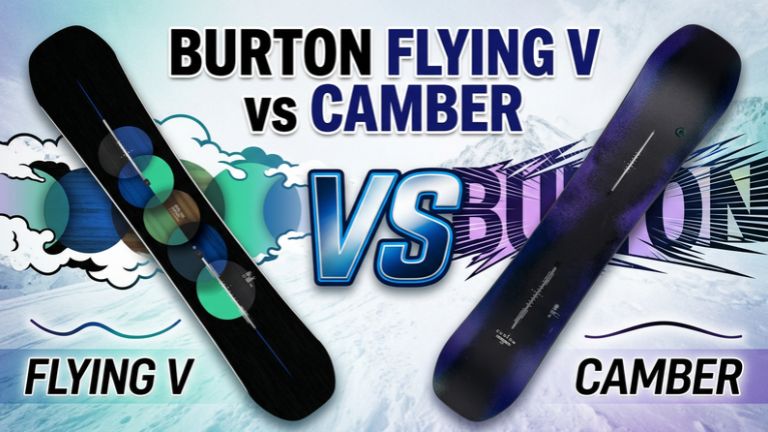
When shopping for flagship Burton snowboards like the Burton Custom or Burton Process, picking the right graphics and core tech is easy, the real decision comes down to what’s underfoot. Burton offers many of its top-tier decks in two distinct profiles: traditional Pure Camber and hybrid Flying V.
Choosing between them fundamentally changes how your board carves, floats, pops, and locks into edges.
The Quick Verdict: Choose Burton Pure Camber if you want high-speed stability, powerful edge hold on hardpack/ice, and explosive pop for carving or jumping. Choose Burton Flying V if you prefer a loose, catch-free feel, effortless float in powder, and quick low-speed maneuvering in trees or terrain parks.
Profile Anatomy & Geometry: The Science Behind the Bend
Before hitting the slopes, understanding how each bend contacts the snow reveals why they perform so differently.
Burton Pure Camber Explained
Burton’s Pure Camber features a continuous upward arch between the tip and tail contact points. When you stand on the board, your body weight flattens this arch, pre-loading the entire edge and driving downward pressure across the whole running length.
- The Ride Feel: Locked-in, responsive, and energetic. It acts like a loaded spring when exiting turns or snapping ollies, but requires clean footwork to avoid catching an edge.
Burton Flying V Explained
Flying V is Burton’s proprietary hybrid rocker/camber profile. It places a rocker zone between your feet, subtle camber zones directly under each foot, and rocker again out toward the tip and tail.
- The Ride Feel: Playful, loose, and surfy. The center rocker point acts as a pivot point for quick, low-effort turns, while the tip and tail rise naturally off the snow to resist catching edges on flat sections or soft landings.
Burton Flying V vs Camber Head-to-Head Model Reviews
1. Burton Custom (Camber) vs. Burton Custom Flying V
The Burton Custom is the most iconic all-mountain snowboard in history. Burton offers this flagship deck in both Pure Camber and Flying V options to suit vastly different riding styles.

Burton Custom Snowboard (Camber & Flying V)
Burton's flagship all-mountain quiver-killer engineered with a light Super Fly II 700G core, carbon highlights, and directional versatile shape.
Key Specs:
-
Shape: Directional Twin
-
Flex: Medium / Stiff (6/10)
-
Core: Super Fly II 700G Core with Dualzone EGD & Carbon Highlights
Highlights & Key Features
- Super Fly II 700G Core: Uses stronger, lighter wood species across key areas to provide pop, strength, and reduced overall weight.
- 45° Carbon Highlights: Full-length carbon layer woven into the fiberglass matrix to reduce weight and fine-tune torsional stiffness.
- Frostbite Edges: Strategic edge extensions underneath your bindings that bite into hardpack and icy conditions.
Riding the Custom Camber feels like controlling a precision high-speed carver. On steep groomers and firm mornings, the full-length camber drives deep, clean trenches without washing out. It demands active leg work and good technique, but rewards you with unmatched stability and energetic rebound out of every turn.
In contrast, the Custom Flying V transforms this hard-charging deck into a playful, surfy all-mountain cruiser. Turn initiation is practically effortless at lower speeds, making tree runs and powder bowls far less demanding on your legs. While it sacrifices some high-speed edge hold on hardpack, it yields a forgiving, catch-free ride that floats over fresh powder effortlessly.
2. Burton Process (Camber) vs. Burton Process Flying V
Made famous by pro rider Mark McMorris, the Burton Process is a freestyle-leaning resort favorite designed to balance park agility with all-mountain fun.

Burton Process Snowboard (Camber & Flying V)
A lightweight, playful twin board designed for freestyle progression, park laps, and effortless resort riding.
Key Specs:
-
Shape: Pure Twin
-
Flex: Medium-Soft (4/10)
-
Core: FSC Certified Super Fly II 700G with Squeezebox Core Profiling
Highlights & Key Features
- True Twin Shape & Flex: Perfectly symmetrical from tip to tail for balanced riding whether regular or switch.
- Squeezebox Core Profiling: Alternates thicker and thinner core sections to transfer energy outward from beneath your feet to the tip and tail.
- Scoop Tip & Tail: Exaggerated 3D tip and tail scooping that turns up the edges for catch-free buttering and landing forgiveness.
The Process Camber is a staple for riders who love jump lines, side hits, and halfpipes. The continuous camber arch gives you rock-solid stability on big jump landings and provides explosive snap when loading up for ollies. It holds an unyielding edge on hardpack park features while keeping the overall feel light underfoot.
The Process Flying V, on the other hand, is the ultimate jib-and-butter machine. The center rocker makes press tricks, flat-ground spins, and low-speed rails feel incredibly natural and hook-free. It’s ideal for intermediate park riders or casual groomer cruisers who want a soft-landing, stress-free board that won’t punish minor footwork mistakes.
Direct Head-to-Head Comparison
1. Edge Hold & Ice Performance
- Pure Camber: Drives direct pressure across the full length of the edge. On icy East Coast groomers or hardpack, Camber bites into the surface and holds a clean line without slipping.
- Flying V: Because the center rocker lifts the contact points slightly, you have less effective edge touching hard snow. It can feel loose or slick on icy hardpack unless you apply extra foot pressure directly over the Frostbite edges.
2. Pop & Snap
- Pure Camber: The gold standard for energy rebound. Loading up the tail on a Camber deck snaps you high off jumps and side hits with predictable, explosive spring energy.
- Flying V: Delivers decent pop from the underfoot camber zones, but lacks the rigid spring-back of a traditional camber line. Pop feels softer and relies more on board flex.
3. Powder & Float
- Flying V: Outstanding natural buoyancy. The rocker sections at the center and tips automatically lift the nose above deep snow, reducing rear-leg burn in powder.
- Pure Camber: Requires more speed and active weight distribution to keep the nose afloat in deep snow, often needing a setback stance on powder days.
4. Forgiveness & Catch-Free Riding
- Flying V: Highly forgiving. Flat-basing across cat tracks, buttering, and off-axis landings rarely result in an edge catch, making it ideal for relaxing laps.
- Pure Camber: Unforgiving of sloppy footwork. If you drop an edge on flat snow or land skidded off a jump, the contact points will bite quickly.
5. Carving & High-Speed Stability
- Pure Camber: Built for speed and trench-digging carves. The board remains damp, steady, and chatter-free when charging down steep, groomed runs.
- Flying V: Great for quick pivot turns and short-radius maneuvers, but tends to chatter or feel twitchy when pushing high speeds on steep slopes.
Performance Comparison
| Performance Category | Pure Camber | Flying V |
| Carving & Edge Hold | 5 / 5 | 3 / 5 |
| High-Speed Stability | 5 / 5 | 3.5 / 5 |
| Powder Float | 3.5 / 5 | 5 / 5 |
| Pop & Ollies | 5 / 5 | 3.5 / 5 |
| Butter / Playfulness | 3 / 5 | 4.5 / 5 |
| Catch-Free Forgiveness | 2.5 / 5 | 5 / 5 |
| Beginner Friendliness | 2.5 / 5 | 4.5 / 5 |
Final Verdict: Which Should You Buy?
Buy Burton Pure Camber if:
- You love laying down deep carve lines at high speeds on groomed runs.
- You frequently ride hardpack, icy conditions, or man-made snow.
- You want maximum pop for park jumps, halfpipes, and aggressive ollies.
- You are an intermediate-to-advanced rider looking to maintain clean, precise edge control.
Buy Burton Flying V if:
- You prefer a surfy, playful, and catch-free riding experience.
- You spend plenty of time hunting for powder stashes or riding in soft snow.
- You want an easy-turning board for tight tree runs, side hits, and low-speed butter tricks.
- You are a beginner or early intermediate looking for a forgiving deck that boosts riding confidence.