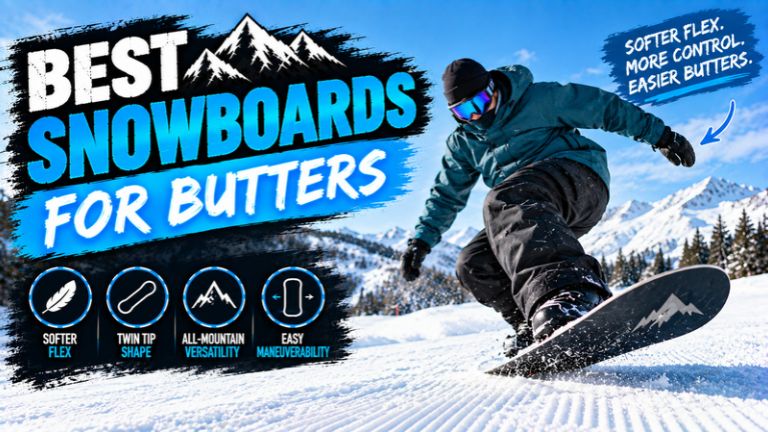
A good butter comes down to a board that bends easily, pivots on its flat base, and forgives a sloppy edge. We compared the best snowboards for butters, focusing on soft to mid-soft flex ratings, twin shapes, and profiles that make pressing and rotating on the snow feel effortless.


Bataleon Disaster Snowboard
- Soft 2/10 flex for easy pressing and butters
- 3BT shaping lifts the sidebase to reduce edge catches
- Wide center base gives a stable platform to press from
- Independent test score of 89.7 out of 100
- Loose feel, not built for charging at speed
- Aimed at park and jib riding more than all-mountain terrain
Overview
The Disaster is Bataleon’s dedicated jib deck, a true twin with a soft flex, low camber, and a skate-like feel that makes pressing and butters feel natural.
Key features and benefits
- Soft 2/10 flex
- True twin shape with a centered stance
- Low camber with 3BT and SideKick technology
- Poplar and beech Core Core with Bi-Ax glass
- FlexWalls urethane sidewalls
Why We Recommend It
We rank the Disaster first because it is built around the exact things a butter needs. A soft 2/10 flex bends under a small shift of weight, so the nose or tail presses without a fight, and the low camber keeps the ride relaxed.
Bataleon’s 3BT shaping starts with a traditional camber for pop and edge hold, then lifts the edges toward the tip and tail. That reduces hang-ups when you slide on a flat base, and the Jib 3BT version has the widest center base in the range, which gives you stability to press and pivot from.
An independent test scored the Disaster 89.7 out of 100 and described a loose, light feel. The full poplar core with beech stringers strengthens the backbone and adds pop, which keeps the board from feeling dead despite the soft flex.
Retailers describe it as a forgiving freestyle board that excels on rails, boxes, and butters. For riders who spend their days pressing, spinning, and playing on small features, this is the most purpose-built pick on the list.
2. Lib Tech Skate Banana Snowboard
Lib Tech Skate Banana Snowboard
- Hybrid rocker Banana profile makes pressing easy
- Magne-Traction serrated edges add grip
- True twin shape rides the same both ways
- Sintered base
- Less edge hold than a camber board on hard snow
- Feels loose at higher speeds
Overview
The Skate Banana is the board that popularized rocker snowboards, and it is still one of the most iconic, playful twins you can ride.
Key features and benefits
- Hybrid rocker (Banana) profile
- True twin shape
- Magne-Traction serrated edges
- Dual wood core
- Sintered Knife Cut base
Why We Recommend It
We include the Skate Banana because its profile is made for this trick. A rocker section in the middle acts as a pivot point, so when your weight shifts to one tip the other lifts easily, which makes locking into a press and rotating through a butter feel simple.
An independent tester called it one of the looser, surfier boards around and said butter and ground tricks were its biggest strengths, along with small jibs, jumps, and side hits. It felt like a 4/10 flex on snow even though Lib Tech rates it higher.
Rocker usually costs you some edge hold, and Lib Tech’s Magne-Traction serrated edges are the answer. They add contact points that bite into firm snow, so the board holds an edge better than you would expect for something this loose.
For riders who want a surfy, playful twin that butters on groomers and floats in soft snow, it remains one of the best picks you can buy.
3. Rome Boneless Snowboard
Rome Boneless Snowboard
- Twin Diamond 3D shaping lifts the tips for catch-free pressing
- Mid-soft flex that feels softer than its 5/10 rating
- Fusion Camber keeps grip underfoot
- Independent test score of 85.9 out of 100
- Solid but not exceptional on hardpack and groomers
- The 157 is a wide size, so check it fits your boots
Overview
The Boneless is Rome’s playful take on freestyle-flexing all-mountain riding, built for riders who want to press, pop, and carve everywhere from park laps to pillow lines.
Key features and benefits
- True twin tri-radial shape
- Twin Diamond 3D shaping in the nose and tail
- Fusion Camber profile
- Bamboo Omega HotRods and Flax Impact Plates
- SinterStrong base
Why We Recommend It
We include the Boneless because its shaping does real work for butters. Twin Diamond 3D raises the contact points in the nose and tail, so the ends press and pivot without catching, while the board stays stable edge to edge.
Rome rates the flex at 5 out of 10, but one tester measured it at 3.5 by hand and said that with the 3D shaping, the Boneless can butter with close to no effort. That tester also noted it is not a hard-charging board, which is a fair trade for this much looseness.
Fusion Camber keeps positive camber underfoot with small rocker pockets at the contact points, so you still get some edge hold. Bamboo Omega HotRods and Flax Impact Plates add pop and absorb landings without deadening the flex.
One thing to check: Rome sells the 157 as a wide size, with a waist around 264mm. If you want this deck, make sure that width suits your boots.
4. CAPiTA Ultrafear Snowboard
CAPiTA Ultrafear Snowboard
- Light P2 Superlight core with carbon boosters for pop
- Full cork edge dampening reduces chatter
- Presses and butters easily despite a 5.5/10 rating
- Independent test score of 88.0 out of 100
- Weak in soft, uneven snow
- Likes slow to moderate speeds more than high speeds
Overview
The Ultrafear is a legendary park and jib board, built in Austria and known for pairing easy pressing with real ollie power.
Key features and benefits
- True twin with a radial sidecut
- P2 Superlight core with carbon boosters
- 1.5mm full cork edge dampening
- Resort V1 profile with Flat Kick tech
- SuperDrive ADV sintered base
Why We Recommend It
We include the Ultrafear because it solves the usual trade-off between buttery and poppy. CAPiTA rates the flex at 5.5 out of 10, but a long-term tester said it feels softer than that, closer to a 4, and found it easy to butter and press while still hitting jumps well.
The Resort V1 profile uses traditional camber for pop, with zero camber sections for predictable turn initiation and landings. A tester also called it light, easy flexing in the tip and tail, and an excellent jibber.
The 1.5mm full cork edge dampening system absorbs impacts and cuts chatter on rails and landings. It earned an 88 out of 100 in an independent review, which also noted it feels agile and light at slow to moderate speeds.
For intermediate to advanced riders who want a poppy, durable twin that still butters on command, this is a strong, proven choice.
5. YES Shifter Snowboard
YES Shifter 3D Snowboard
- Soft 4/10 flex presses easily
- Y3D tips reduce edge catching
- True twin rides switch the same
- Independent test score of 85.9 out of 100
- Soft flex means less help at speed
- Handles crud better than expected but still not great
Overview
The YES Shifter is a soft-flexing twin built for park riding and jibbing, with 3D shaped tips that give it a more direct edge feeling than a traditional twin.
Key features and benefits
- Soft 4/10 flex
- True twin shape
- Y3D tips that reduce edge catching
- Lightweight wood core
- Extruded base
Why We Recommend It
We include the Shifter because an independent tester described the soft flex as soft enough to press easily but not so soft that it felt like it could fold up underneath them. That is exactly the balance a butter board needs.
The combination of easy pop, quick turning, and a playful flex made it great for hunting little hits all over the mountain. The soft flex and forgiving shape also make it easy to get creative without worrying about catching an edge.
It is a true twin with a centered stance, so it will not do much of the work for you at speed. The same tester found it handled crud better than expected, though still not amazing.
For riders who want a forgiving, playful twin for small features and slow, creative riding, this is a smart, well-reviewed pick.
6. CAPiTA Pathfinder Snowboard
CAPiTA Pathfinder Snowboard
- Soft 4/10 flex suits progression
- Park V2 profile with zero camber underfoot and lifted contact points
- Dual core with a 2-year warranty
- Affordable for what it offers
- A tester found it not as buttery as expected for its flex and size
- Basic extruded-style value build, not a premium deck
Overview
The Pathfinder is CAPiTA’s value freestyle board, a throwback blunted twin that has long been called one of the best consumer buys in the game.
Key features and benefits
- True twin with a radial sidecut
- Twin 4 flex
- Park V2 profile with Flat Kick tech
- Dual core and Magic Bean resin
- 2-year warranty
Why We Recommend It
We include the Pathfinder because the Park V2 profile is made for loose, catch-free riding. A zero camber section through the insert area gives a stable, skate-style feel, while elevated contact points turn quickly and keep presses and butters easy.
CAPiTA says the shorter, blunted tip and tail reduce swing weight, which helps with pivots and spins. An independent tester found an earlier camber version easy to butter, with a snappy, springy feel, though not as buttery as its soft flex first suggested.
It also costs far less than most boards here. Retailers rate it for beginner to intermediate riders, so it is a sensible first freestyle deck.
For riders who want a forgiving, affordable twin to learn butters and park basics, this is one of the best value picks on the list.
7. Rome Artifact Snowboard
Rome Artifact Snowboard
- Soft 4/10 flex with a buttery feel
- Stay Positive Camber keeps edge hold and pop
- Bamboo HotRods load ollies without stiffening the board
- Decent carver for a freestyle board
- Camber takes a little more effort to butter than rocker
- Not suited to beginners
Overview
The Artifact is a mellow-flexing true twin that loves to lap the park and jib the whole mountain, and it is one of the few full camber boards still aimed at jib riders.
Key features and benefits
- True twin shape with a radial sidecut
- Stay Positive Camber
- 4/10 flex
- Bamboo HotRods and Flax Impact Plates
- Twin Double Kick and an extruded base
Why We Recommend It
We include the Artifact for riders who like the snap of camber but still want a board that butters. Rome says the Bamboo HotRods are designed to load ollies while staying buttery soft, and the 4/10 flex backs that up.
An independent review scored it 83.2 out of 100 and called it a really decent carver for a freestyle board. It suits someone who wants something not too aggressive and not too playful, with a stable feel on the rest of the mountain.
Honesty about the trade-off: an older review of the camber version noted it takes a little more effort to butter than the rockered Artifact. In return you get more snap and a more predictable feel.
For intermediate riders who want a soft twin with real camber pop, this is a dependable, well-loved choice.
8. Nidecker Sensor Snowboard
Nidecker Sensor Snowboard
- Mid-soft flex is playful and forgiving
- True twin shape with a centered stance
- SideKick edges smooth out rough terrain
- Absorbnid topsheet absorbs vibration
- Less loose than the rocker-dominant boards here
- Fewer independent reviews than the bigger names
Overview
The Sensor is a park-tuned true twin that stays ready for the whole mountain, with a mid-soft flex that is easy to press and manipulate.
Key features and benefits
- Mid-soft flex
- True twin shape
- SideKick lifted edges
- Master Core of poplar and paulownia
- Absorbnid topsheet
Why We Recommend It
We include the Sensor because Nidecker describes its mid-soft flex as letting you get creative across the whole mountain, from park hits to powder butters. That is the kind of all-mountain looseness many riders want.
SideKick lifts the edges at the widest points of the nose and tail, which gives more float in powder, smoother riding in rough terrain, and easy turn initiation. The true twin shape keeps presses on either end feeling the same.
The Master Core combines poplar and paulownia for a light, strong, responsive feel, and the Absorbnid topsheet soaks up vibration so long sessions feel less tiring.
For riders who want a forgiving, versatile twin that butters without being a pure jib deck, this is a solid, approachable pick.
9. Ride Moderator Snowboard
Ride Moderator Snowboard
- Softer 4/10 nose locks into presses easily
- Carbon Array 3 and Linear Carbon add pop
- Rides switch well for a directional board
- Slim Walls dampen vibration
- Directional shape is less symmetrical than a true twin
- More all-mountain than butter-first
Overview
The Moderator is a unisex, directional all-mountain board with a camber-dominant profile, and it surprised testers by being easy to press despite its directional shape.
Key features and benefits
- Directional Extra Camber profile
- Medium 5/10 flex with a softer nose
- Carbon Array 3 and Linear Carbon laminates
- Slim Walls urethane sidewalls
- Sintered stone-ground base
Why We Recommend It
We include the Moderator as the pick for riders who want butters on a more serious all-mountain board. A tester called it a nose-presser’s dream in a camber-dominant directional package, because the longer nose pairs with a softer 4/10 flex.
It gets its pop from a light core, the extra camber profile, and well-placed carbon stringers. The same tester noted it is noticeably lighter than earlier Ride models and rides switch well for a directional board.
Ride says to ride the Moderator at your standard length, with no downsizing needed. It is aimed at intermediate to advanced riders who want one deck for groomers, trees, and powder, with butters as a bonus.
For riders who want a directional all-mountain board that still presses and rides switch well, this is a capable, versatile choice.
10. GILSON Undead Snowboard
GILSON Undead Snowboard
- USA-made and custom built to order
- Poplar hardwood core with a sintered Ptex base
- 3D base comes standard
- 5-year warranty
- Very little independent testing available
- No flex rating published in the listing
Overview
GILSON builds the Undead to order in the USA as a hybrid camber freestyle board for aggressive riders who want to push limits across varied terrain.
Key features and benefits
- Hybrid camber freestyle design
- Poplar hardwood core
- Sintered Ptex base
- 3D base standard on every unit
- Sizes from youth 100 to 159 Wide, 5-year warranty
Why We Recommend It
We include the Undead as a different kind of option: a custom, American-made freestyle board with unusually strong warranty coverage. Each one is built to order and backed by a 5-year warranty.
It is worth being direct about what we do not know. There is very little independent testing of this board and the listing does not publish a flex rating, so we cannot promise how buttery it feels the way we can for the boards above.
What the listing does say is encouraging: a poplar core, a sintered Ptex base, and a 3D base as standard, with sizes from youth 100 up to 159 Wide. If you value domestic manufacturing and a long warranty, it is worth a look.
For riders who want a made-to-order freestyle deck and are comfortable with fewer reviews to lean on, it is a unique pick.
Final Thoughts
The best snowboards for butters share a few traits: a soft or mid-soft flex, a twin or near-twin shape, and a profile that keeps the tips from catching. The Bataleon Disaster and Lib Tech Skate Banana lean furthest into that loose, surfy feel, while the Rome Boneless and CAPiTA Ultrafear add more pop and all-mountain ability.
The YES Shifter, CAPiTA Pathfinder, and Rome Artifact give you forgiving flex at friendly prices, and the Nidecker Sensor and Ride Moderator bring a more versatile mountain feel. The GILSON Undead rounds out the list for riders who want a custom, American-made deck.
Whichever one you choose, remember that brands rate flex differently. Several testers felt these boards softer than the published number, so read the on-snow feel as well as the spec sheet.
What is a butter in snowboarding?
A butter is a ground trick where you press down on the nose or tail so the opposite end lifts off the snow, then rotate or pivot while sliding on your flat base. It is usually done on groomers and small side hits at slow to moderate speeds.
What flex is best for butters?
Soft to mid-soft flex works best, since the board bends easily under a small weight shift. Brands rate flex on a 1 to 10 scale, where 1 to 2 is soft and 3 to 5 is medium, and boards like the Bataleon Disaster (2/10) and Rome Artifact (4/10) sit at the buttery end.
Is rocker or camber better for butters?
Rocker is the easiest, because a curve in the middle acts as a pivot point and lifts the tips, which is why the Lib Tech Skate Banana is so loose. Camber boards like the Rome Artifact can still butter, but one older review noted they take a little more effort than a rocker version.
Do I need a twin shape to butter?
A true twin makes presses on either end feel the same, which is why most boards here are twins. A directional board can still work if the nose is soft, and one tester found the Ride Moderator’s 4/10 nose easy to press despite its directional shape.
Should I size down for butters?
Many freestyle and beginner riders go 2 to 4 cm shorter than a standard all-mountain size, since a shorter board is lighter, has less swing weight, and pivots more easily. Ride’s Moderator is an exception, as Ride says to ride it at your standard length.
Are these boards good for beginners learning butters?
Several are well suited. The CAPiTA Pathfinder is rated for beginner to intermediate riders, a retailer lists the YES Shifter for beginner to intermediate, and a review rated the Bataleon Disaster for beginner to advanced. The Rome Artifact and CAPiTA Ultrafear are better for intermediate riders and up.
Do soft boards struggle at speed?
Yes, soft flex trades stability for playfulness. Testers noted the Skate Banana is best for playful riding at lower speeds, the Ultrafear likes slow to moderate speeds, and the Bataleon Disaster has a loose feel, so these are not the boards for charging hard.
Do I need soft bindings for butters?
Softer-flexing bindings generally pair better with a soft board, since stiff bindings can fight the bend you are trying to create. Match the binding’s mounting pattern to the board’s inserts, such as the 2×4 pattern on most boards here.