Most riders do best on a medium flex, and the honest answer for anyone unsure which way to lean is to stay there rather than guess toward stiff.
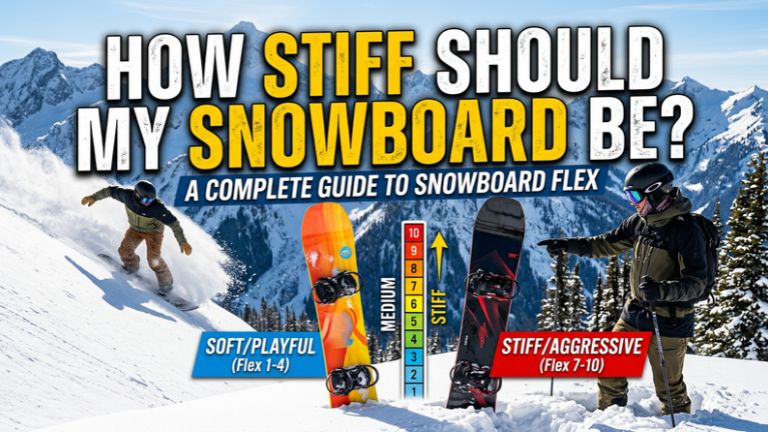
Flex is usually described on a soft-to-stiff scale, and where you land on it should follow three things: how you actually ride, how long you’ve been doing it, and what you weigh relative to the board’s recommended range.
Get any one of those wrong and a board that’s technically “correct” on paper can feel miserable underfoot.
What Soft, Medium, and Stiff Actually Feel Like
Soft flex turns easily at low speed and forgives a badly timed edge change, which is where most riders learn without fighting the board underneath them.
At the other end of the scale, holding a line at speed and through chopped-up or steep terrain is what stiff flex is for, but it punishes hesitation, so a beginner on a stiff board spends their first season getting bucked around rather than progressing.
The compromise that works for the largest share of riders sits in the middle: stable enough to trust at speed, forgiving enough that a mistimed turn doesn’t throw you.
The same tradeoff shows up constantly across our snowboard boot picks, where a mellow flex is built for first-timers finding their feet, a mid-stiff flex is flagged as less forgiving for true beginners, and a firm flex is sold specifically on the aggressive, high-speed response it gives a rider who already knows how to use it.
Board flex works on exactly the same logic, just applied to the deck instead of the boot.
Match the Flex to How You Actually Ride, Not How You Want To
Soft flex suits park riders and anyone still working on buttering and jibbing, because the board needs to bend and pop on command at low speed.
Most people spend most of their time somewhere closer to all-mountain, which is exactly where medium flex earns its keep: it covers groomers, light powder, and the occasional steep pitch without being punishing in any one of them.
Stability at speed and through variable snow is the entire point for freeride, carving, and powder-focused riding, which is why that end of the scale trades away the forgiveness a beginner needs, a tradeoff that matters far less once mistakes are rare.
Weight matters inside all three categories: a flex rating is calibrated to a board’s recommended weight range, and a rider well outside that range can end up with a board that rides stiffer or softer than its stated number suggests, regardless of riding style.
Your Boots and Bindings Have to Match It Too
A stiff board paired with soft boots fights itself: the board wants to hold an edge at speed and the boots can’t transmit the pressure needed to do it, so you get neither the board’s stability nor the boots’ forgiveness.
The reverse is just as common and just as frustrating, a stiff, responsive binding mounted on a soft, playful board that no longer wants to butter or jib the way it’s built to.
The same soft-to-stiff split that applies to the board applies to bindings directly, with firmer bindings sold on the same aggressive, high-speed response and flagged as less forgiving for beginners in exactly the way a stiff board is.
If you already own boots or bindings, matching the new board’s flex to them, rather than picking in isolation, saves a setup from undercutting itself.
For sizing the board itself alongside flex, our snowboard sizing guide walks through the other half of that decision.
When It’s Worth Going Against the Simple Rule
The safe default of medium flex stops being the right call once you know enough to want something specific.
A rider who’s spent two full seasons in the park and still reaches for medium flex is leaving responsiveness on the table that a softer board would hand them.
A confident all-mountain rider who keeps outrunning their board’s stability at speed has outgrown medium and is the exact case stiff flex exists for.
The mistake isn’t picking soft or stiff, it’s picking either one before you have the mileage to know which mismatches you’re actually solving.
The Decision in Short
Start at medium unless your riding style gives you a specific reason not to: soft for park and low-speed learning, stiff for freeride and carving at speed, medium for everything in between and for anyone still finding out which of those they are.
Check your weight against the board’s stated range before trusting the flex number at all, and buy or adjust boots and bindings to match rather than treating the three choices as independent.