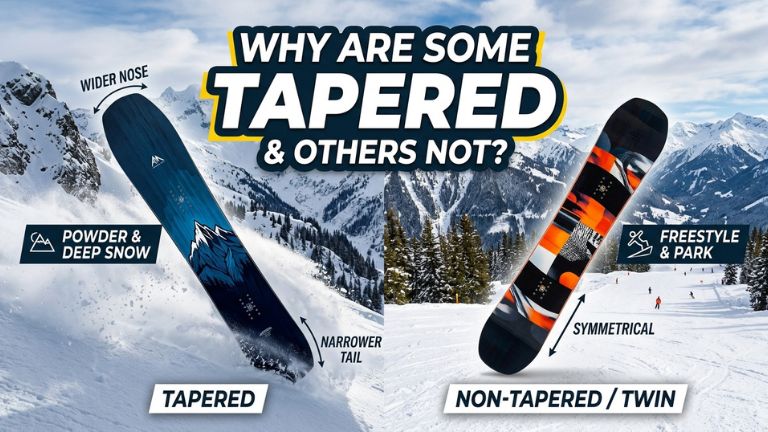
Look closely at a board shaped for powder and you might notice the nose is visibly wider than the tail, a design choice that looks unusual compared to a standard symmetrical shape. Why are some snowboards tapered while others keep the same width front to back? The answer comes down to how a board interacts with deep snow, and understanding it helps explain why taper shows up specifically on certain board categories rather than across the entire market.
Why Are Some Snowboards Tapered
Taper exists specifically to improve how a board floats and performs in deep, ungroomed snow. A wider nose combined with a narrower tail changes how the board displaces snow beneath it, encouraging the nose to rise and plane naturally on top of powder while the narrower tail sinks slightly, helping the board maintain a more natural, effortless float without requiring the rider to constantly lean back to keep the nose up.
Boards not designed with powder as a primary focus generally skip taper, since a symmetrical or twin shape suits the balanced, centered stance and switch riding common in park, freestyle, and general all mountain use far better than an asymmetric, tapered shape would.
Tapered Directional Snowboard
Taper is almost always paired with a directional shape, meaning the board is specifically designed to be ridden primarily in one direction rather than equally well switch. This pairing makes sense given taper’s purpose, since a directional shape already commits to optimizing nose and tail differently for forward riding, and taper simply extends that same directional optimization to the board’s width profile as well.
A directional tapered board typically features a longer, more tapered nose section combined with a shorter, stiffer tail, reinforcing the forward focused design throughout multiple aspects of the board’s shape rather than taper existing as an isolated feature layered onto an otherwise standard shape.
Tapered vs Non-Tapered Snowboard
The core difference comes down to how each shape handles deep snow versus groomed or hardpack conditions. Tapered boards excel specifically in powder, offering that natural float and reduced rider fatigue that comes from not having to fight the board’s width distribution to keep the nose up. Non-tapered, symmetrical boards perform more predictably and consistently across groomed terrain and switch riding, since equal width front to back means equal performance characteristics in either direction.
Riders who split their time primarily between groomed runs and the terrain park generally find non-tapered, twin shaped boards better suited to their needs, while riders who prioritize powder days and deep snow exploration tend to gravitate toward tapered, directional designs specifically built for that environment.
Snowboard Taper Explained
Understanding taper in more technical detail helps clarify exactly how this design feature achieves its intended effect.
Defining Taper Amount
Taper amount refers to the specific width difference between a board’s nose and tail, typically measured in millimeters. Most tapered powder and freeride boards feature somewhere between 3 and 20 millimeters of taper, with more aggressive powder specific models sometimes reaching slightly beyond that range for maximum float in especially deep conditions. A board with 8 millimeters of taper, for example, has a nose 8 millimeters wider than its tail, a modest but meaningful difference that noticeably affects how the board behaves in soft snow without dramatically altering its overall handling on firmer terrain.
The Archimedes Principle of Snow
Board designers sometimes reference a concept informally described as the Archimedes principle of snow, drawing a loose comparison to how a wider hull displaces more water and rides higher in a boat. Applied to a snowboard, a wider nose displaces more snow beneath it, generating more natural lift and float in that section, while the narrower tail displaces less snow and sits somewhat lower. This differential displacement is what creates the nose-up, tail-down natural float tendency tapered boards are specifically designed to achieve without requiring constant rider input to maintain that positioning.
Sidecut Radius Interaction
Taper also interacts with a board’s sidecut, the curved shape along the edges that determines turning radius. Because a tapered board’s nose and tail have different widths, the effective sidecut radius can differ slightly between the two ends, contributing to a turn initiation and exit feel that some riders describe as smoother or more natural in deep snow specifically, compared to how the same sidecut would behave on a symmetrical, non-tapered shape.
Snowboard Shape for Powder
Taper represents just one piece of a broader shape strategy commonly used for powder specific boards. Many powder boards also incorporate a swallowtail or fish tail design, along with increased nose length and setback stance positioning, all working together alongside taper to maximize float and control in deep snow conditions specifically. These combined shape elements distinguish dedicated powder boards from more general all mountain or freestyle shapes, which typically prioritize versatility and predictable, symmetrical handling over the specialized deep snow performance a tapered powder shape delivers.
The Main Benefits of Riding a Tapered Snowboard
Beyond the core floatation mechanics already covered, tapered boards offer several practical benefits riders notice directly during actual powder days.
Fatigue-Free Powder Days
Since a tapered board naturally maintains nose-up float without requiring the rider to constantly lean back or fight the board’s positioning, riders typically experience significantly less leg and core fatigue during long powder days compared to riding a non-tapered board in the same deep snow conditions. This reduced fatigue allows for longer, more enjoyable sessions in powder without the exhausting battle against a board that wants to nose-dive without constant rider correction.
Nimble Tree Riding
The shorter, often stiffer tail section common on tapered boards contributes to quicker, more responsive turning specifically suited to navigating tight spaces between trees, a riding style that demands fast, precise direction changes in variable, often deep snow conditions found in glade terrain.
Smooth Turn Exit
The taper’s effect on sidecut interaction, combined with the narrower tail’s reduced surface area, often produces a smoother, more natural turn exit specifically in powder, allowing the board to release from a turn without the abrupt, sometimes jarring sensation a symmetrical board’s wider tail can produce when pushing through deep, resistant snow.
How Much Taper Actually Matters
Taper amount alone does not tell the full story of how a board floats, since it works together with overall width, length, and stance setback rather than acting as an isolated factor. Two boards with the same taper measurement can still feel noticeably different in powder if one has a significantly wider overall platform or a more aggressive setback stance than the other. Riders comparing tapered boards should look at the complete shape profile rather than fixating on the taper number alone, since a smaller taper paired with strong setback and a generous nose can sometimes outperform a larger taper measurement on a board with less complementary shape support elsewhere.
Final Thoughts
Understanding why some snowboards are tapered while others are not comes down to recognizing taper as a purpose built solution for deep snow performance, rather than a universal feature every board benefits from equally. The width difference between nose and tail, combined with complementary shape choices like directional design and setback stance, work together to deliver natural float, reduced fatigue, and smoother handling specifically in powder conditions.
Riders who prioritize groomed runs, park features, or switch riding will generally find a non-tapered, symmetrical shape better suited to their needs, while dedicated powder and deep snow riders stand to benefit significantly from the specific advantages a tapered design delivers exactly where it matters most.