Burton sits at the top of most riders’ minds when they think of snowboard brands, and that recognition comes with a price tag to match. Why are Burton snowboards so expensive compared to some competing brands? The answer involves genuine proprietary technology, a dedicated research facility, sustainability certifications, and a warranty program that together justify a meaningful chunk of that cost.
Why Are Burton Snowboards So Expensive
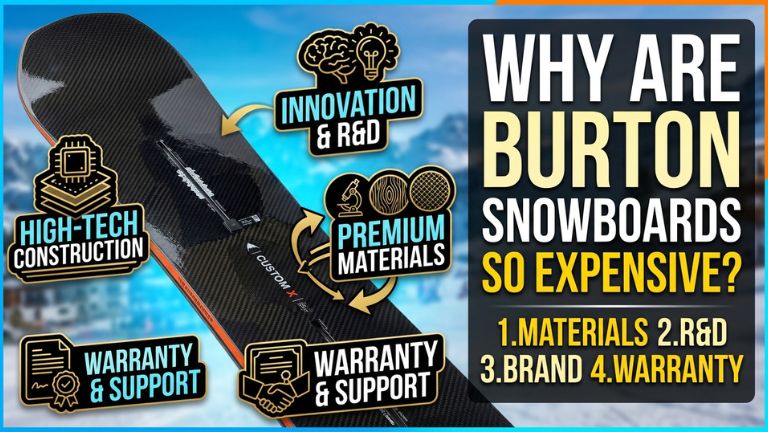
Burton’s pricing reflects a combination of factors that go beyond simple brand markup. Proprietary technologies developed and refined over decades, a dedicated prototyping facility that tests new designs before they reach the public, formal sustainability certifications that require ongoing investment to maintain, and a well regarded warranty and service program all contribute to the final retail price. Each of these elements represents real cost to Burton as a company, translated into what riders pay at checkout.
Burton Channel System Cost
Burton’s Channel binding mounting system replaced the brand’s earlier proprietary 3D disc pattern with a continuous track that allows stepless, infinitely adjustable stance width. Developing and tooling this system required significant engineering investment, and it remains compatible with bindings from other major brands rather than locking riders into Burton bindings exclusively, which is itself a notable design choice. This kind of proprietary mounting technology adds manufacturing cost compared to a simpler, standard 4×4 hole pattern used by many competing brands.
Super Fly Wood Cores and Squeezebox
Burton’s Super Fly core technology uses a combination of stronger and lighter wood species positioned in specific areas of the core to balance pop, strength, and reduced weight. Building on this, Burton’s Squeezebox core profiling varies the core’s thickness along the board’s length, creating thicker, more powerful sections paired with thinner, more flexible zones to improve overall pop and performance. Both technologies require more precise manufacturing than a simple, uniform core construction, adding cost tied directly to performance benefit.
Frostbite Edges and Flying V Profiles
Frostbite Edges extend the metal edge slightly beyond the sidewall specifically beneath the bindings, improving edge hold on hard, icy conditions without sacrificing playfulness elsewhere on the board. Flying V is one of Burton’s blended camber and rocker profiles, combining rocker zones between and outside the feet for float and playfulness with camber zones underfoot for edge control and pop. These blended profile designs require more complex shaping during manufacturing compared to a single, uniform camber or rocker profile throughout the entire board.
Step On Interface Integration
Burton’s Step On system uses a pin and lever mechanism built into specifically designed boots that click directly into compatible bindings, eliminating traditional straps entirely. Engineering this interface to be both secure and easy to use required extensive testing and precise manufacturing tolerances between the boot and binding components, representing a genuinely different mechanical system compared to traditional strap based bindings rather than a simple styling variation.
Craig’s Prototype Facility
Craig’s Prototype Facility, named after longtime Burton team rider Craig Kelly, is a roughly 10,000 square foot research and development space located next to Burton’s global headquarters in Burlington, Vermont. The facility houses high end, custom built machinery capable of producing prototype boards that riders and engineers can test on snow within a day of building them. This dedicated R&D investment, along with the limited edition Burton Custom Shop boards actually built there, contributes to the company’s overall cost structure in a way that smaller brands without comparable facilities do not carry.
B Corp Certification and Sustainable Sourcing
Burton became the world’s first snowboard company to achieve Certified B Corporation status in 2019, a certification that requires meeting high verified standards for social and environmental performance, transparency, and accountability, along with recertification through a detailed assessment process every three years. Burton also sources wood cores that are Forest Stewardship Council certified and has worked toward using bluesign approved materials across its softgoods line. Maintaining these certifications and sourcing standards involves ongoing auditing and material costs that factor into overall pricing.
W48 Warranty Support
Burton backs its snowboards with a three year limited warranty covering defects in materials or workmanship, longer than the one year warranty Burton applies to boots, bindings, helmets, and goggles. Warranty service runs through Burton’s W48 program, which aims to process and return a warranty claim within 48 hours of receiving the product, a notably fast turnaround compared to standard industry warranty service times. Maintaining dedicated staff and infrastructure to support this level of service responsiveness represents an ongoing operational cost built into the price of every board sold.
Burton Snowboards Price vs Performance
Whether Burton’s pricing translates into proportionally better performance depends on how much a given rider’s needs align with the specific technologies covered above. Riders who benefit from precise stance adjustability, blended camber and rocker profiles, or the quick entry convenience of Step On bindings are paying for features with direct, tangible performance impact rather than purely cosmetic differentiation.
For riders who do not need or use these specific features, comparable performance can often be found at a lower price point from other established brands using simpler, more standard construction methods. This makes the value equation genuinely dependent on individual riding style and priorities rather than a simple yes or no answer that applies universally to every rider considering a Burton purchase.
Are Burton Snowboards Worth It?
For riders who prioritize proprietary technology, want the option of Step On convenience, or value supporting a company with verified sustainability credentials and a strong warranty program, Burton’s pricing is reasonably justified by what that price actually delivers. The three year board warranty and fast W48 service program in particular offer tangible peace of mind that not every competing brand matches.
For budget conscious riders or those whose riding style does not specifically benefit from Burton’s signature technologies, other established brands can offer strong performance at a lower price point. The decision ultimately comes down to whether the specific features Burton has invested in align with what you personally value and will actually use on the mountain.
Brand Value: Legacy, Marketing and Rider Team
Beyond the technical and structural factors already covered, Burton’s decades long history as one of the sport’s founding companies contributes meaningfully to its brand value and pricing power. Founded by Jake Burton Carpenter in 1977, the company played a foundational role in growing snowboarding from a niche activity into a recognized global sport, and that history carries real weight with many riders choosing gear today.
Burton also maintains a substantial professional rider team and marketing presence, both of which represent ongoing investment reflected in the brand’s overall cost structure. While this brand equity does not directly change how a specific board performs on snow, it does factor into the broader value many riders associate with the Burton name, whether through trust built over decades or simply the cultural cachet of riding a historically significant brand within the sport.
Final Thoughts
Understanding why Burton snowboards are so expensive comes down to recognizing the real, verifiable investment behind the price, from proprietary technologies like the Channel system and Squeezebox core profiling to Craig’s dedicated prototype facility, B Corp certification, and the three year W48 backed warranty. These are not simply marketing dressing, but genuine engineering, sustainability, and service commitments that carry real cost.
Whether that cost is worth it for you depends on how much you value those specific features and services compared to what other brands offer at different price points, making this a personal calculation rather than a universal verdict on Burton’s pricing.