Getting the fit right is one of the most overlooked parts of buying snowboard gloves. Riders often focus on warmth ratings, waterproofing, or style, but fit plays just as big a role in keeping hands warm and comfortable all day. A glove that fits poorly can leave you with cold fingers or a clumsy grip no matter how well insulated it is.
This guide breaks down exactly how snowboard gloves should fit, what to check for when trying on a new pair, and common sizing mistakes to avoid.
Why Fit Matters More Than People Think
Understanding how snowboard gloves should fit starts with recognizing that a lot of riders assume warmth comes down entirely to insulation thickness. In reality, fit plays a huge role in how warm your hands actually feel. Gloves that are too tight restrict blood flow, which ironically makes your hands colder even with excellent insulation. Gloves that are too loose let cold air circulate inside, undoing the benefit of any insulation layer.
Fit also affects dexterity and control. A properly fitted glove lets you grip your board, adjust bindings, and use zippers without fumbling around, while a poorly fitted pair makes even simple tasks frustrating.
The Ideal Fit: Snug But Not Tight
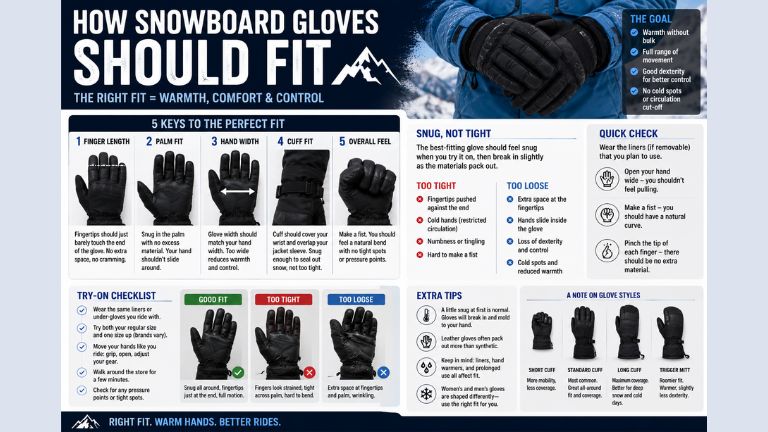
The general rule for how snowboard gloves should fit is snug but not restrictive. You should be able to make a full fist and wiggle all your fingers without feeling significant resistance from the fabric. There should not be large gaps of empty space at the fingertips, but you also should not feel your fingers pressed tightly against the fabric at the seams.
A helpful way to check fit is to make a fist while trying the gloves on. If you feel any pinching, restriction, or numbness developing quickly, the gloves are likely too small. If your fingers slide around loosely inside with noticeable empty space at the tips, they are probably too large.
Checking the Fingertip Space
Fingertip fit deserves special attention, since this is one of the most common problem areas. Ideally, your fingertips should reach close to the end of the glove’s fingers without being jammed all the way to the tip. A small amount of space, similar to what you would want in a properly fitted shoe, allows for natural movement and a thin air pocket that actually helps retain warmth.
Too much space at the fingertips reduces dexterity and can make gloves feel bulky or clumsy. Too little space compresses circulation right at the tips, which are already the coldest part of your hand in cold weather.
Palm and Grip Fit
The palm area should feel snug against your hand without excess loose fabric bunching up when you close your fist. Excess material in the palm can interfere with your grip on rails, straps, or your board itself, especially in wet or slippery conditions.
At the same time, the palm should not feel so tight that it restricts your ability to fully close your hand. Test this by mimicking common motions like gripping a strap or adjusting a binding buckle while trying the gloves on in the store.
Wrist and Cuff Fit
The wrist and cuff area plays an important role in keeping cold air and snow out, so this deserves attention too. A good fitting cuff should close snugly around your wrist, either with an adjustable strap or elastic, without leaving gaps that let drafts in.
At the same time, the cuff should not feel so tight that it cuts off circulation at the wrist, which can make your entire hand feel colder over time. Adjustable wrist straps offer the most flexibility here, since you can fine tune the tightness based on how the rest of the glove fits.
Should You Size Up for Liners
Many riders wonder whether they should size up if they plan on wearing a liner glove underneath for extra warmth. In most cases, gloves designed with liners in mind already account for that extra layer in their standard sizing, so sizing up is usually unnecessary and can lead to a fit that is too loose overall.
If you find that adding a liner makes your usual size feel uncomfortably tight, that may be a sign to try the next size up specifically for colder days when you know you will be layering. Trying gloves on with the liner in place, rather than guessing, gives the most accurate sense of fit.
Common Sizing Mistakes
A handful of sizing mistakes come up again and again among riders shopping for new gloves. Buying gloves too large thinking it adds warmth is one of the most common issues, since excess space actually reduces warmth by allowing more cold air to circulate inside.
Ignoring brand specific sizing charts is another frequent mistake. Glove sizing varies noticeably between brands, so a medium in one brand might fit closer to a small or large in another. Always check the specific brand’s sizing chart rather than assuming your usual size will translate directly.
Skipping the in person try on process, especially when ordering online, can also lead to a poor fit. If you must order online without trying gloves on first, measuring your hand carefully and comparing it against the brand’s specific size chart reduces the risk of a bad fit significantly.
How to Measure Your Hand for Glove Sizing
If you are ordering online or want to double check your usual size, measuring your hand takes just a minute. Wrap a soft measuring tape around your dominant hand at the widest point, usually across the knuckles excluding the thumb. Compare this measurement in inches or centimeters against the specific brand’s sizing chart, since these numbers vary between manufacturers.
Taking this extra step before ordering saves the hassle of exchanges and gives you a much better starting point than guessing based on your regular clothing size.
Trying Gloves On the Right Way
When trying gloves on in a store, take a few extra minutes to properly test the fit rather than just sliding them on and checking if they generally feel okay. Make a full fist several times, mimic gripping motions you would use while riding, and check for any pinching or restriction around the knuckles or wrist.
Wearing the same base layer or liner you plan to use on the mountain while trying gloves on gives a much more accurate sense of true fit compared to trying them bare handed.
Signs Your Current Gloves Do Not Fit Right
If you already own a pair of gloves and are unsure whether the fit is correct, a few signs can help you tell. Consistently cold fingertips despite good insulation often points to a fit that is too loose, allowing cold air to circulate inside. Numbness or tingling that develops quickly after putting gloves on usually signals a fit that is too tight and restricting circulation.
Excess bunching in the palm that interferes with grip, or a wrist cuff that never quite seals out drafts, are both signs worth addressing with a different size or style on your next purchase.
Final Thoughts
Knowing how snowboard gloves should fit comes down to finding that snug but not restrictive balance throughout the entire hand. Pay close attention to fingertip space, palm fit, and how the wrist cuff seals against drafts. Taking the time to try gloves on properly, ideally with the liner or base layer you plan to wear, makes a noticeable difference in warmth and comfort on the mountain.
A well fitted pair of gloves might seem like a small detail, but it can be the difference between a comfortable day of riding and constantly thinking about cold, numb fingers.