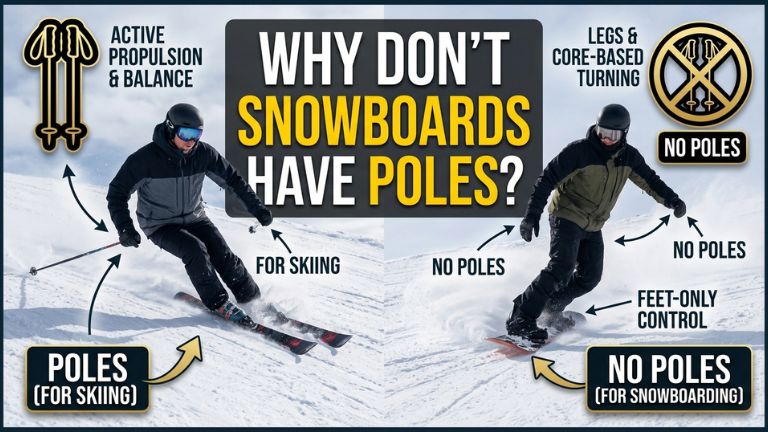
Anyone who has skied before trying snowboarding for the first time often notices the absence of poles almost immediately, and it can feel strange heading down the mountain without something to push off with. Why don’t snowboards have poles the way skis do? The answer comes down to fundamental differences in stance, biomechanics, and how each sport generates movement and control.
Do Snowboarders Use Poles
No, snowboarders do not use poles as part of standard equipment, and this holds true across every discipline of the sport, from casual all mountain riding to competitive halfpipe and slopestyle events. This is a consistent, universal difference from skiing rather than a personal preference some riders adopt and others skip.
Why Don’t Snowboards Have Poles
Several interconnected factors explain why poles never became part of standard snowboard equipment, unlike their essential role in skiing.
Stance and Physics
Skiing involves a forward facing stance with both feet moving somewhat independently, and poles serve a genuine physical purpose in that context, helping with balance, timing turns, and providing propulsion on flatter sections. Snowboarding uses a fundamentally different sideways stance with both feet fixed to a single board, which changes how balance and propulsion work at a basic physical level, removing much of the functional need poles serve in skiing.
Safety
Holding poles while riding a snowboard would introduce a significant injury risk during falls, since a rigid pole gripped in your hand during a tumble could cause wrist, shoulder, or facial injuries in ways that simply are not a comparable concern in skiing’s more controlled, forward facing falling patterns. This safety consideration alone would make poles a poor design choice for snowboarding even before considering functional necessity.
Hand Utility
Snowboarders frequently use their hands for balance, touching the snow briefly during certain turns or maneuvers, and for grabs during tricks in the terrain park. Poles would physically interfere with these movements, restricting exactly the kind of free hand use that has become integral to how the sport is actually ridden and performed at every skill level.
Biomechanics: Sideways Stance vs Forward Stance
Understanding the deeper biomechanical differences between the two sports clarifies why poles matter for one and not the other.
Skiing Stance
Skiers face forward, with both skis pointing in the same general direction as their body and hips. This forward orientation means the arms and hands, aided by poles, can contribute meaningfully to balance, rhythm, and propulsion, since the body’s natural forward facing posture allows poles to plant rhythmically alongside the direction of travel.
Snowboarding Stance
Snowboarders stand sideways relative to the direction of travel, with the board perpendicular to their hips and shoulders. This sideways orientation means the arms naturally extend out to the sides for balance rather than forward and back, a position where a pole would not integrate naturally into the body’s balance mechanics the way it does in skiing’s forward facing stance.
Center of Gravity
The sideways stance in snowboarding also shifts how a rider manages their center of gravity, relying heavily on ankle, knee, and hip movement across the board’s single connected platform to control balance and turning. Skiing’s forward stance, by contrast, distributes balance across two independently moving skis, and poles help bridge and stabilize that more complex, distributed balance system in a way that snowboarding’s single board simply does not require.
4 Reasons Ski Poles Would Ruin Snowboarding
Beyond simply being unnecessary, poles would actively work against several core aspects of how snowboarding functions as a sport.
Severe Injury Risk During Falls
Snowboard falls often involve tumbling or rolling motions distinct from typical ski falls, and a rigid pole held during this kind of fall creates real potential for wrist fractures, shoulder dislocations, or facial injury from the pole itself during impact, a risk that outweighs any potential balance benefit poles might otherwise offer.
Destruction of Freestyle and Balance
Freestyle riding, including grabs, spins, and rail tricks, depends entirely on free hand movement and unrestricted upper body rotation. Poles would physically prevent grabs and interfere with the rotational mechanics tricks require, effectively making an entire dimension of the sport impossible to perform as it currently exists.
Incompatible Turn Mechanics
Snowboard turns are initiated and controlled through weight shifts and edge angle changes across a single board, a mechanism that does not benefit from pole plants the way ski turns often do. Attempting to incorporate poles would not meaningfully assist this turning method and would instead simply add an obstructing object to manage during every turn.
Lift Loading and Carrying Hazard
Loading and riding chairlifts already requires snowboarders to manage a single board, and adding poles would create additional items to juggle, carry, and potentially drop or mishandle during lift loading, unloading, and general movement around a crowded base area, adding hazard without offsetting benefit.
How Snowboarders Handle Flat Sections Without Poles
Flat sections present a genuine challenge without poles for propulsion, and snowboarders have developed several specific techniques to handle this situation.
Unstrapping and Skating
One common approach involves unstrapping the back foot from the binding and using that free foot to push and skate across flat terrain, similar to how someone would push a skateboard, while the front foot remains strapped in and resting on the board.
Pumping and Edge Surfing
Experienced riders often use a pumping technique, generating momentum through rhythmic weight shifts and edge engagement along undulating terrain, similar to how a skateboarder pumps through a bowl, extracting speed from the terrain itself rather than needing external propulsion.
The Penguin Walk
For very short flat stretches, riders sometimes keep both feet strapped in and use small, waddling hops or shuffling steps, informally known as the penguin walk, to inch the board forward across minor flat sections without needing to unstrap at all.
Getting a Pull
On longer flat sections, particularly common at the bottom of certain runs or connecting paths, snowboarders sometimes grab onto a passing skier’s pole or a friend’s hand for a brief pull across the flat area, a practical, informal solution that has become a recognized part of mountain culture in areas where flat runouts are common.
Could Poles Ever Work for Snowboarding?
It is worth briefly addressing whether some modified version of poles could theoretically work for snowboarding, since the question sometimes comes up among curious beginners. In practice, no equipment manufacturer has seriously pursued this, and the biomechanical mismatch covered throughout this guide explains why. Unlike ski poles, which integrate naturally into a forward facing stance with independently moving legs, any pole based accessory for snowboarding would need to work around a sideways stance and a single connected board, fighting against rather than supporting the sport’s fundamental movement patterns.
Some backcountry snowboarders do use a single collapsible pole, sometimes called a whippet or a modified ski pole, but this is a specialized tool for specific situations like traversing flat backcountry terrain or self arresting on steep, icy slopes, not a standard piece of resort riding equipment. Even in these niche cases, the pole is typically stowed away during actual descent and turning, reinforcing rather than contradicting the core reasons poles do not belong in mainstream snowboarding.
Final Thoughts
Understanding why snowboards don’t have poles comes down to the fundamentally different stance, biomechanics, and movement patterns that separate snowboarding from skiing at a basic physical level. The sideways stance, reliance on free hand movement for tricks and balance, and genuine safety concerns during falls all make poles incompatible with how the sport actually works, rather than poles simply being an accessory that snowboarding happened to skip.
While flat sections remain a genuine challenge without the propulsion poles provide skiers, techniques like skating, pumping, and the penguin walk have become effective, sport specific solutions that snowboarders learn and rely on instead, reflecting the different biomechanical foundation the entire sport is built around.